
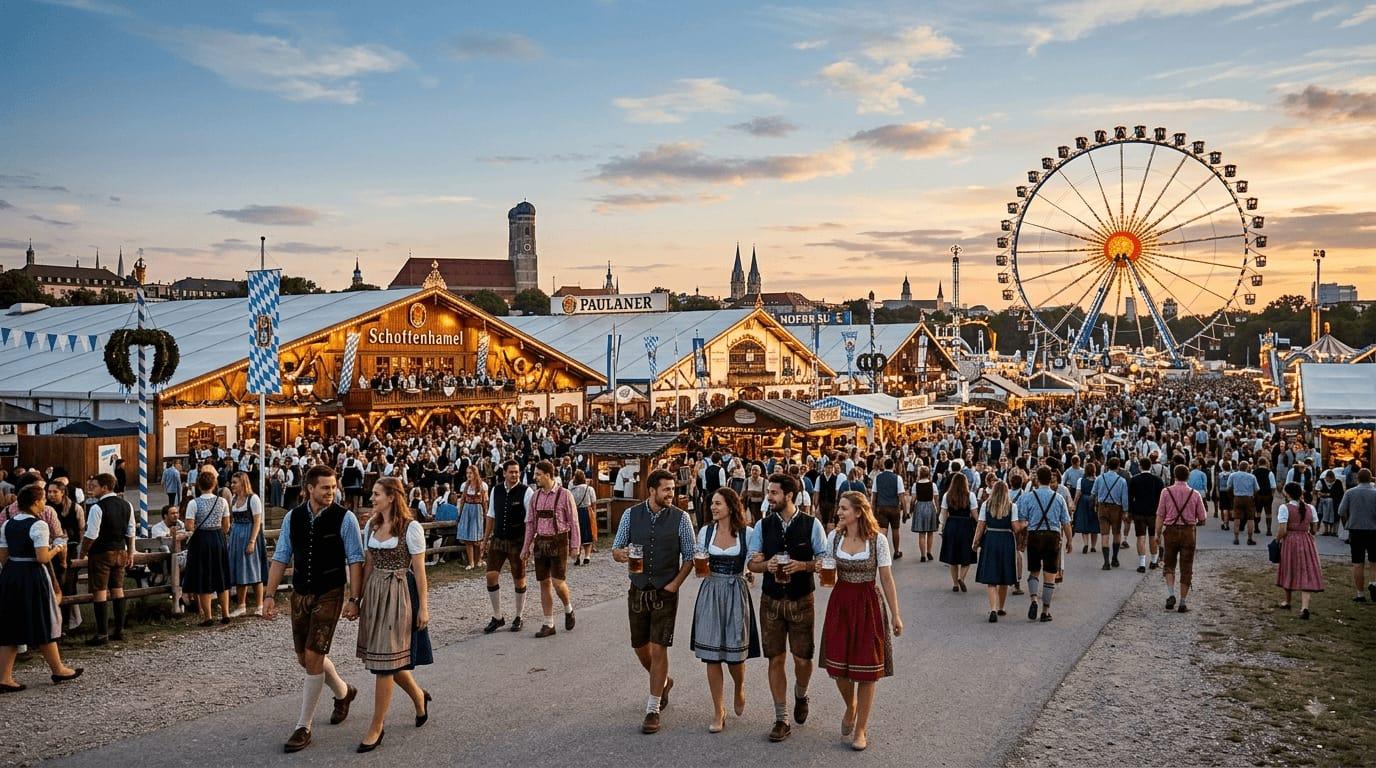
Oktoberfest is the world's largest folk festival (Volksfest), drawing over six million visitors to Munich, Germany, every autumn to experience Bavarian hospitality, centuries-old traditions, hearty culinary specialties, and iconic beer tents. For international travelers—especially first-timers coming from the United States, the United Kingdom, Italy, Australia, Austria, Poland, Japan, and beyond—attending Oktoberfest 2026 is a bucket-list cultural adventure. Because Munich undergoes peak tourism pressure during these sixteen days, starting your trip planning early is essential to secure affordable accommodation, navigate transport seamlessly, and maximize your festival experience.
Oktoberfest 2026 at a Glance
Event: 191st Munich Oktoberfest (Wiesn)
Location: Munich, Bavaria, Germany
Dates: Saturday, September 19 – Sunday, October 4, 2026
Duration: 16 days
Venue: Theresienwiese (Wiesn)
Expected Visitors: ~6.5 to 7 million
International Visitors: ~20% (Top markets: USA, Italy, UK, Austria, Poland, Australia, Japan)
Official Website: oktoberfest.de
Nearest Transport Hubs: Munich Central Station (Hauptbahnhof), Munich Airport (MUC), U-Bahn station Theresienwiese (U3/U6, U4/U5)
What Is Oktoberfest?
Oktoberfest originated on October 12, 1810, as a Royal Bavarian wedding celebration honoring Crown Prince Ludwig (later King Ludwig I) and Princess Therese of Saxe-Hildburghausen. The citizens of Munich were invited to celebrate on the fields outside the city gates, which were named Theresienwiese ("Therese's Meadow") in honor of the bride. The festivities concluded with a popular horse race, creating a tradition that locals loved so much it was repeated annually. Over the decades, agricultural shows, small amusement booths, and beer stands were added, eventually evolving into the massive beer halls, thrill rides, and global spectacle known today.
To Munich locals, the festival is affectionately called the Wiesn, short for Theresienwiese. While international visitors often view it primarily as a massive beer celebration, Oktoberfest is a deeply rooted Bavarian folk festival. Beyond the beer, it showcases traditional brass band music (Blaskapelle), centuries-old folk costumes (Trachten), regional craftsmanship, family-friendly carnival games, historic rides, and iconic culinary heritage.
When Is Oktoberfest 2026?
Oktoberfest 2026 officially begins on Saturday, September 19, 2026, and runs through Sunday, October 4, 2026.
Oktoberfest 2026 Key Milestones:
[Sept 19: Opening Parade & Keg Tapping] ──> [Sept 20: Costume & Riflemen's Parade] ──> [Sept 27: Outdoor Brass Concert] ──> [Oct 4: Gun Salute Closing]
Why Is Oktoberfest Held in September?
Although named Oktoberfest, the festival takes place mostly in September. In 1872, organizers shifted the starting date forward to take advantage of the warmer, sunnier, and longer daylight hours of late Bavarian summer. The schedule was structured so that the festival's final weekend always touches October.
Event Highlights Across the Festival Schedule
Opening Weekend (Sept 19–20): On Saturday at 11:00 AM, the Parade of Landlords and Breweries winds through the streets. At exactly 12:00 PM (noon), Munich’s Lord Mayor taps the first beer keg inside the Schottenhamel tent, shouting "O'zapft is!" ("It is tapped!"). Only after this moment is beer officially served across all tents. Sunday features the famous Costume and Riflemen’s Parade (Trachten- und Schützenzug), where 10,000 participants march in traditional regional dress.
Weekdays (Mon–Thu): The grounds are significantly calmer until mid-afternoon. This is the ideal window for walk-ins seeking tent seating without pre-existing table reservations.
Family Days (Sept 22 & Sept 29): Discounted rates on rides, games, and performances run until 7:00 PM on Tuesdays.
Middle Weekend ("Italian Weekend", Sept 25–27): Traditionally attracts large numbers of visitors from Northern Italy, creating a vibrant, energetic atmosphere. Sunday morning features the outdoor brass band concert at the foot of the Bavaria Statue.
Final Weekend & Closing (Oct 2–4): High energy and emotional farewells. The festival ends on Sunday, October 4, at 12:00 PM with a traditional gun salute (Böllerschießen) under the Bavaria Statue, followed by sparklers and candlelit brass sing-alongs inside the tents that evening.
Where Is Oktoberfest Held?
The festival takes place at the Theresienwiese, a 42-hectare open venue located in Munich's Ludwigsvorstadt-Isarvorstadt district, just southwest of the city center.
Central Munich Transport Connections to Theresienwiese:
[Munich Airport (MUC)] ──S1/S8 (45 min)──> [Hauptbahnhof] ──U4/U5 (2 min) or Walk (12 min)──> [Theresienwiese]
Access & Public Transit Options
From Central Station (Hauptbahnhof): Theresienwiese is located less than 1 kilometer south of Hauptbahnhof. You can walk to the northern entrance in roughly 12 to 15 minutes.
Via U-Bahn (Subway):
U4 / U5 Lines: Station Theresienwiese drops passengers right at the main entrance. During peak evening hours, station Schwanthalerhöhe (one stop west) offers a far less crowded exit/entrance.
U3 / U6 Lines: Station Goetheplatz or Poccistraße puts you within a 5- to 8-minute walk of the eastern and southern festival perimeters.
Via S-Bahn (Commuter Rail): Take any central line (S1–S8) to Hackerbrücke, then follow the pedestrian bridge signs for a direct 10-minute walk south to the grounds.
Do You Need Tickets for Oktoberfest?
No entrance ticket is required to enter the Oktoberfest grounds or any beer tent. Admission to Theresienwiese and general access into all fourteen large beer halls and over twenty smaller tents is 100% free.
Oktoberfest Access Breakdown:
├── Festival Grounds Entrance ──> Free (No ticket)
├── Beer Tents Entrance ─────────> Free (No ticket)
├── Table Reservations ──────────> Minimum consumption vouchers required (No ticket fee)
└── Rides, Games & Food ─────────> Pay-as-you-go cash/card
Key Clarifications on Entry & Reservations
Grounds & Tents: You do not pay an admission fee at the gates. Security guards perform bag checks at all perimeters.
Beer Tents: Anyone can walk into a tent for free if capacity allows. However, during busy periods (evenings and weekends), tents close their doors once maximum capacity is reached.
Table Reservations: Reservations are managed directly by individual tent operators, not a central ticketing agency. Reservations themselves do not cost money; instead, reserving a table requires purchasing a minimum consumption voucher package (typically two 1-liter beers and half a roast chicken per person).
Oide Wiesn (Historic Oktoberfest): The dedicated heritage section at the southern end of the grounds charges a nominal admission fee of €4 (children under 14 enter free) to access vintage rides, historic tents, and traditional brass music exhibitions.
Oktoberfest Beer Tents: What You Need to Know
The main festival grounds feature 14 large beer halls accommodating up to 10,000 people each, surrounded by more than 20 medium and small specialized tents.
Tent Seating Rules:
[Walk-In Seats] ──> Unreserved wooden benches marked "Frei" / First-come, first-served
[Reserved Tables] ──> Marked with time slots / Reserved for minimum consumption voucher holders
How the Tents Work
Seating Policy: By Munich regulation, beer can only be served to visitors who are seated at a table (or standing at designated high tables in unreserved areas). Standing in walkways to order drinks is prohibited.
Walk-in Visitors: Large tents keep roughly 20% to 50% of their seating unreserved, particularly on weekday afternoons and unreserved central aisle tables. Walk-in guests should look for wooden benches without reservation placards or ask service staff where open seating is available.
Music Evolution: Tents remain cozy and atmospheric during the day, featuring traditional brass bands playing quiet folk music. Around 6:00 PM, the atmosphere shifts: brass bands pivot to international party hits and German pop (Schlager), and guests stand on benches (never on tables) to sing and dance.
Major Oktoberfest Beer Tents Overview
Schottenhamel (Spaten Brewery | ~10,000 Capacity): Historic venue of the opening Mayor's keg tap; high energy, popular with younger crowds and student groups.
Hofbräu-Festzelt (Hofbräu Brewery | ~10,000 Capacity): World-famous, highly international atmosphere; features a large standing-only area (Stehbereich) near the stage.
Augustiner-Festhalle (Augustiner Brewery | ~8,500 Capacity): Widely considered the most authentic local tent; serves beer from traditional wooden casks (Holzfass); family-friendly.
Hacker-Festzelt (Hacker-Pschorr Brewery | ~9,300 Capacity): Iconic "Bavarian Heaven" interior ceiling painting; legendary evening acoustics and energetic rock-brass band.
Käfer's Wies'n-Schänke (Paulaner Brewery | ~3,300 Capacity): Log-cabin aesthetic; high-end gourmet dining; popular with celebrities; stays open past midnight (until 1:00 AM).
Marstall (Spaten Brewery | ~4,200 Capacity): Upscale, horse-carriage themed interior; excellent culinary selection and refined atmosphere near the main entrance.
Armbrustschützenzelt (Paulaner Brewery | ~7,500 Capacity): Hosts the traditional German Crossbow Championships inside the hall; warm rustic Bavarian decor.
Bräurosl (Hacker-Pschorr Brewery | ~8,200 Capacity): Named after the brewer’s daughter; hosts the famous "Gay Sunday" celebration on the first weekend.
What to Eat and Drink at Oktoberfest
Every drop of beer served at Oktoberfest is brewed strictly within Munich city limits in compliance with the Bavarian Beer Purity Law (Reinheitsgebot) of 1516, which mandates only water, barley, hops, and yeast.
Traditional Oktoberfest Meal Pairing:
[1 Litre Oktoberfest Märzen / Festbier] + [1/2 Hendl (Roast Chicken) + Brezn (Pretzel)]
Traditional Bavarian Specialties
Das Maß (Mass): The standard 1-liter glass mug of Oktoberfest beer. Oktoberfest beers are specially brewed Märzen or Festbier styles with a slightly higher alcohol content (5.8% to 6.3% ABV) and a golden malt balance.
Wiesn-Hendl: Crispy, golden butter-roasted half chicken, seasoned with paprika and parsley—the staple Oktoberfest meal.
Riesenbrezn: Giant soft Bavarian pretzels, baked fresh with coarse salt crystals—perfect for sharing and soaking up alcohol.
Schweinebraten & Schweinshaxe: Roasted pork loin or crispy braised pork knuckle served with dark beer gravy and potato dumplings (Knödel).
Weißwurst: Traditional Bavarian poached white veal sausages flavored with parsley and lemon, served with sweet mustard and a pretzel (traditionally eaten before noon).
Obatzda: A savory Bavarian cheese spread made from aged Camembert, butter, paprika, onions, and a splash of beer, served with pretzels or rye bread.
Steckerlfisch: Whole freshwater trout or mackerel grilled on wooden skewers over open charcoal pits.
Vegetarian & Vegan Options: Modern Oktoberfest tents offer meat-free alternatives such as Kässpatzen (Bavarian egg noodles with melted cheese and fried onions), oat-milk dumplings, vegetable strudels, and plant-based roasts.
Non-Alcoholic Beverages: Tents offer non-alcoholic beer (Alkoholfreies Bier), Spezi (a popular German mix of cola and orange soda), sparkling apple juice (Apfelschorle), and water.
Responsible Drinking Tip: Oktoberfest beer goes down easily but packs a heavy punch due to its elevated alcohol content and high volume. Pace yourself, alternate each Maß with water, and eat hearty food early in your visit.
How Much Does Oktoberfest 2026 Cost?
Entering Oktoberfest is free, but food, drinks, rides, and souvenirs require careful budgeting. Official 2026 prices for beer and food will be published by the City of Munich in June 2026. Below are estimated costs based on recent festival adjustments.
Estimated Costs Overview
1 Liter Beer (Maß): €15.20 – €16.50 (Plus optional tip of ~€1–€2 per glass)
1 Liter Non-Alcoholic / Water: €11.00 – €12.50 (Sodas and mineral water inside tents)
Wiesn-Hendl (Half Roast Chicken): €16.00 – €20.00 (Classic main tent meal)
Giant Soft Pretzel (Brezn): €6.50 – €8.50 (Sold by roving pretzel vendors)
Hearty Main Dish (Pork Knuckle): €22.00 – €32.00 (Served with dumplings and cabbage)
Carnival Rides / Attractions: €5.00 – €12.00 (Price per ride)
Public Transport (Day Pass): €9.20 – €16.00 (Single-day MVV pass within Munich)
Sample Daily Travel Budgets (Per Person / Excluding Accommodation)
Budget Traveler (€70 – €100 / day)
2 Beers (Maß) inside a tent
1 Pretzel & 1 Street food meal (e.g., Bratwurst outside tent)
Munich MVV Transport Group/Day Ticket
1 Carnival ride or historic Oide Wiesn entry
Mid-Range Traveler (€150 – €250 / day)
3–4 Beers inside tents
Full sit-down lunch (Roast Chicken) & dinner inside tents
Pretzels and snacks
2–3 Carnival thrill rides
Souvenir mug or gingerbread heart (Lebkuchenherz)
Premium Traveler (€350+ / day)
Pre-booked tent table reservation package
Multi-course gourmet dining in Käfer or Marstall tent
Champagne, wine, or premium digestifs
Taxi / rideshare transport
Official merchandise and authentic regional clothing
Where to Stay for Oktoberfest 2026
Accommodation in Munich fills up fast for Oktoberfest, with hotel prices spiking 100% to 300% above standard rates. Book your hotel or apartment 6 to 10 months in advance.
Munich Accommodation District Priority:
[1. Ludwigsvorstadt / Hauptbahnhof] ──> Walk to Wiesn (0-15 mins) / Highest price
[2. Maxvorstadt / Altstadt] ─────────> City center charm / 10-15 mins transit
[3. Outer Transit Corridor (U/S-Bahn)] ──> Budget friendly / 20-30 mins direct train
Top Neighborhoods for Festival Visitors
Ludwigsvorstadt & Hauptbahnhof: Located directly adjacent to the Theresienwiese. You can walk to the tents in 5 to 15 minutes, avoiding crowded subway trains late at night.
Schwanthalerhöhe: Located directly west of the festival meadow. Offers a neighborhood feel with great local bakeries and immediate pedestrian access to the western festival entrance.
Altstadt-Lehel & Maxvorstadt: Munich’s historic center and university district. Ideal for sightseeing, high-end boutique hotels, and dining, located a brief 10-minute U-Bahn ride away.
Outer Transit Corridors (Laim, Pasing, Ostbahnhof, Giesing): Staying along the central S-Bahn trunk line (Stammstrecke) or U4/U5 lines keeps travel times under 25 minutes while offering significantly lower nightly room rates.
Nearby Bavarian Towns: If Munich hotels are fully booked, consider staying in historic commuter towns like Augsburg, Freising, Rosenheim, or Dachau. Frequent regional trains run to Munich Central Station in 25 to 45 minutes.
How to Get to Oktoberfest
Arriving in Munich
Via Munich Airport (MUC): Germany’s second-largest airport connects to major global hubs across North America, Europe, Asia, and Australia. Take S-Bahn train line S1 or S8 from the terminal basement straight to Munich Hauptbahnhof (40–45 minutes).
Via Train (Munich Hauptbahnhof): High-speed ICE trains link Munich directly to Frankfurt (3.5 hours), Berlin (4 hours), Vienna (4 hours), Zurich (3.5 hours), and Salzburg (1.5 hours).
Arriving at Munich Airport (MUC):
[Terminal Exit] ──> Take S-Bahn S1 or S8 ──> Central Station (Hauptbahnhof) [45 mins] ──> Walk to Theresienwiese [12 mins]
Navigating Munich via MVV Public Transport
Munich’s public transport network (MVV) is clean, efficient, and punctual.
Tickets: Purchase a single-day ticket (Tageskarte) or a group day ticket (Gruppen-Tageskarte, valid for up to 5 adults) covering Zone M (entire city center).
Payment: Buy tickets through ticket machines at stations or digitally via the MVGO or DB Navigator mobile apps. Always validate paper tickets at blue stamping machines before boarding platform escalators.
What to Wear to Oktoberfest
While there is no dress code for Oktoberfest—everyday casual clothes like jeans and t-shirts are completely fine—over 80% of attendees dress in traditional Bavarian attire (Trachten). Wearing authentic garments enhances the festive experience.
Bavarian Trachten Basics:
 Men: Lederhosen (Leather breeches) + Trachten shirt + Wool socks/Haferlschuhe
 Women: Dirndl (Bodice + Blouse + Skirt + Apron with bow-knot code)
Traditional Garment Overview
Lederhosen (For Men): Durable leather breeches made from goat, cow, or deer skin, held up by suspenders (Hosenträger). Paired with a checkered or solid white linen shirt, tall wool socks (Trachtensocken), and sturdy leather shoes (Haferlschuhe).
Dirndl (For Women): A traditional Bavarian dress consisting of a fitted bodice (Mieder), a low-cut white blouse (Dirndlbluse), a full skirt, and an apron (Schürze).
The Dirndl Bow Knot Code: Pay attention to where you tie your apron bow!
Tied on the Left: Single / Available.
Tied on the Right: Married, engaged, or in a relationship.
Tied in the Center: Young girl or undecided.
Tied in the Back: Widowed, or waitress.
Dressing Responsibly
Avoid cheap costume outfits (plastic/nylon "Halloween-style" Lederhosen or short, neon party Dirndls). Locals view cheap costumes as disrespectful to Bavarian heritage. Either invest in a quality leather pair or authentic cotton Dirndl from local shops (e.g., Angermaier, Lodenfrey, or secondhand vintage shops), or wear comfortable everyday clothes.
What Is the Weather Like in Munich During Oktoberfest?
Late September and early October mark the seasonal transition from late summer to autumn in Southern Bavaria.
Typical Autumn Weather in Munich:
[Daytime Highs] ──> 14°C to 20°C (57°F to 68°F) / Sun or mild breeze
[Evening Lows]  ──> 5°C to 10°C (41°F to 50°F) / Cool, crisp conditions
Daytime: Mild and pleasant, usually ranging between 14°C and 20°C (57°F to 68°F). On sunny days, outdoor beer gardens (Freibereich) outside tents are comfortable.
Nighttime: Temperatures drop quickly after dark, dipping to 5°C to 10°C (41°F to 50°F).
Precipitation: Crisp sunny days (Altweibersommer) are common, but autumn rain showers occur. Bring an umbrella or water-resistant jacket.
What to Pack for Oktoberfest 2026
[ ] Passport & Valid ID: Required for identity verification and age checks.
[ ] Cash (Euros): While card payments are increasingly accepted, cash is preferred inside busy beer tents for faster tipping and transactions.
[ ] Comfortable Flat Footwear: You will walk several miles daily across cobbled streets and gravel grounds. High heels are strongly discouraged.
[ ] Layered Clothing: Light clothing for warm, packed tent interiors combined with a warm sweater/jacket for chilly evening walks outside.
[ ] Compact Rain Jacket or Umbrella: Compact travel protection for sudden autumn downpours.
[ ] Portable Power Bank & Cable: Battery life drains quickly when capturing photos, videos, and navigating public transit.
[ ] Travel Power Adapter: Type C/F EU plug adapter for charging devices.
[ ] Small Crossbody Bag / Purse: Bags larger than 3 liters (roughly 20cm x 15cm x 10cm) are prohibited on the festival grounds for security reasons. Large backpacks must be checked in at security lockers outside the perimeters.
[ ] Active Germany eSIM / Mobile Data Plan: Crucial for app-based navigation, digital public transport tickets, and contacting friends.
Staying Connected at Oktoberfest: Why an eSIM Can Help
Reliable mobile connectivity is essential when navigating a massive festival ground like Theresienwiese. When thousands of people gather inside steel-framed beer tents, standard roaming connections can slow down, making mobile data vital for effortless communication.
International Traveler Mobile Setup Options:
├── Traditional Roaming ──> Expensive daily rates / Speeds may drop
├── Local Physical SIM ───> Long queues at airport/store / Requires swapping physical cards
└── Travel eSIM (Digital) ─> Pre-install before flight / Dual-SIM convenience / Instant local data
Essential Uses for Mobile Data at Oktoberfest
Meeting Separated Groups: Finding friends on crowded grounds using real-time location sharing.
Navigating Public Transit: Checking live train departure platforms via the MVGO or DB Navigator apps.
Language Translation: Reading authentic food menus and tent signage instantly using translation apps.
Mobile Payments & Digital Banking: Buying transit passes or managing digital funds securely on the go.
Advantages of a Travel eSIM
An eSIM (Embedded SIM) is a digital chip built into modern smartphones that allows you to activate a mobile data plan without inserting a physical plastic card.
Instant Setup: Buy and install your Germany data profile online before stepping on your flight.
Dual-SIM Functionality: Keep your primary home phone number active for incoming security SMS verification codes while using the local eSIM for affordable high-speed cellular data.
No Store Queues: Avoid standing in long queues at airport kiosks after a long international flight.
Travel Recommendation: If you are traveling from outside the European Union, consider setting up a dedicated Germany eSIM or wider Europe eSIM through providers such as CloudOn before departing. Having active mobile data the moment your flight lands at Munich Airport ensures stress-free navigation straight to the festival grounds.
Best Time to Visit Oktoberfest
Crowd Density & Seating Accessibility Matrix:
[Weekday Morning/Afternoon] ──> Low crowds / Easiest table seating / Family-friendly
[Weekday Evening] ───────────> Medium-High crowds / Lively music / Arrive by 4:00 PM
[Weekend All-Day] ───────────> Extreme crowds / Tents fill early / Plan ahead
Best for Walk-In Seating: Monday through Thursday before 3:00 PM. Tents are spacious, service is quick, and atmosphere allows for relaxed conversations.
Best for Maximum Party Atmosphere: Friday evenings, Saturdays, and Sundays. Tents reach maximum capacity early (often by 11:00 AM on Saturdays).
Best for Families: Tuesdays (Official Family Days) and daytime hours at the nostalgic Oide Wiesn, which features vintage rides and folk dancing.
Best for Photography: Early morning (8:30 AM – 10:00 AM) before beer tents open, when the festival alleyways are quiet, clean, and bathed in morning light.
How Many Days Should You Spend in Munich?
A 3- to 4-day trip offers the ideal balance between experiencing Oktoberfest and exploring Munich’s historic attractions.
Recommended 4-Day Munich & Oktoberfest Split:
 Day 1: Central Munich Altstadt Tour & Marienplatz
 Day 2: Full Day Oktoberfest Festivities (Theresienwiese)
 Day 3: Munich Culture (Residenz, English Garden, Museums)
 Day 4: Bavarian Day Trip (Neuschwanstein Castle or Lake Starnberg)
Sample 3-Day Oktoberfest Munich Itinerary
Day 1: Historic Munich & Arrival
Morning: Arrive at Munich Central Station or Munich Airport. Check into your hotel and drop off heavy luggage.
Afternoon: Take a walking tour of Munich's Altstadt (Old Town). Stand in Marienplatz to watch the historic Glockenspiel performance at 12:00 PM or 5:00 PM inside the New Town Hall (Neues Rathaus). Walk to the nearby Viktualienmarkt open-air food market for fresh snacks and local cheeses.
Evening: Enjoy a traditional dinner at a classic Munich brewery tavern, such as the Augustiner-Bräustuben or the world-famous Hofbräuhaus, to warm up for the festival days ahead.
Day 2: The Oktoberfest Deep-Dive
9:00 AM: Arrive at Theresienwiese via U-Bahn (Exit station Theresienwiese or Schwanthalerhöhe). Walk down the main avenue (Wiesnstraße) to admire the grand tent facades and decorated horse-drawn brewery wagons.
10:00 AM: Secure unreserved table seating inside a classic tent like Augustiner-Festhalle or Hacker-Festzelt. Order your first Maß of Oktoberfest beer and a freshly baked giant pretzel.
1:00 PM: Feast on a classic Bavarian lunch of roasted chicken (Wiesn-Hendl) or pork knuckle (Schweinshaxe).
4:00 PM: Exit the tents to explore the outdoor fairground. Ride the giant Riesenrad (Ferris Wheel) for panoramic views of Munich and the Alps, or try traditional carnival games.
6:30 PM: Experience the heritage charm of the Oide Wiesn (Historic Oktoberfest) section. Enjoy traditional folk music, vintage merry-go-rounds, and beer served in stone mugs (Steinkrug).
Day 3: Bavarian Culture & Farewell
10:00 AM: Stroll through the lush trails of the English Garden (Englischer Garten), one of the world's largest urban parks. Watch skilled river surfers ride the permanent standing wave at the Eisbachwelle.
1:00 PM: Tour the opulent royal halls of the Munich Residenz (former urban palace of Bavarian monarchs) or explore world-class art at the Alte Pinakothek.
5:00 PM: Return to Theresienwiese for a final evening visit inside a high-energy tent like Schottenhamel or Hofbräu-Festzelt, singing along to brass band tunes as the festival lights glow across the grounds.
Things to Do in Munich Beyond Oktoberfest
Marienplatz & Neues Rathaus: The historic central square of Munich dominated by gothic architecture and the iconic clock tower performance.
English Garden (Englischer Garten): Expansive green city park featuring walking paths, the Chinese Tower beer garden, and the Eisbach river surfing wave.
Viktualienmarkt: Munich's famous daily outdoor gourmet food market, serving artisan sausages, regional cheeses, fresh flowers, and local beer.
Munich Residenz: The massive historic palace complex showcasing centuries of Bavarian royal treasures, ornate courtyards, and gilded halls.
Nymphenburg Palace (Schloss Nymphenburg): The grand baroque summer residence of Bavarian kings surrounded by manicured gardens and canals.
BMW Welt & BMW Museum: Modern architectural landmark dedicated to automotive engineering, featuring historical vehicle exhibitions and interactive technology displays.
Deutsches Museum: One of the world’s largest science and technology museums, located on an island in the Isar River.
Oktoberfest Tips for First-Time Visitors
Bring Euro Cash: While card adoption has grown, cash ensures swift tipping and seamless transactions with busy tent servers and outdoor food stalls.
Arrive Early on Weekends: On Saturdays and Sundays, tents reach capacity early in the morning. Arrive by 8:30 AM – 9:00 AM if you do not have a reservation.
Tip Your Server Promptly: Round up your drink bill generously on your first order (e.g., hand €20 for a ~€16 beer and tell the server to keep the change). Generous tippers receive faster service during busy hours.
Never Stand on Tables: Standing on wooden benches is traditional and encouraged during party songs, but stepping on tables leads to immediate ejection by tent security.
Pace Yourself: Oktoberfest beer is stronger than standard lagers. Drink water between beers and avoid drinking on an empty stomach.
Establish a Group Meeting Spot: Cellular networks inside metal tents can get congested. Agree on a clear physical landmark outside (e.g., the base of the giant Bavaria Statue) to reunite if separated.
Oktoberfest Etiquette and Safety
Respecting Tent Security: Security staff (Ordner) enforce safety rules strictly. Follow their instructions promptly when entering or exiting crowded sections.
Souvenir Mug Theft Is Illegal: Stealing a glass Maßkrug mug from a tent is a federal criminal offense in Germany. Security personnel inspect bags at exits. If you want a mug as a souvenir, purchase an official licensed mug from authorized stalls on the grounds.
Toast Properly: When clinking glasses (Prost!), hold the glass mug handle securely, clink at the bottom of the glass, and make direct eye contact with your drinking partner.
Safe Environment: Oktoberfest maintains strict safety standards. Safe spaces, medical centers (Sanitätsstation), and lost-and-found stations are operated continuously near the Bavaria Statue behind the tents.
Is Oktoberfest Worth Visiting for International Travelers?
Yes, Oktoberfest is a remarkable cultural bucket-list destination. For travelers who appreciate lively social atmosphere, rich regional traditions, historic architecture, and festive music, there is no event on earth quite like it. While accommodation prices are premium and crowds are large, the combination of Bavarian hospitality, world-class beer, traditional culinary heritage, and international camaraderie makes Oktoberfest an unforgettable travel experience.
Oktoberfest 2026 Planning Checklist
[ ] 10–12 Months Before: Confirm travel dates (Sept 19 – Oct 4, 2026).
[ ] 8–10 Months Before: Reserve Munich hotel rooms or apartments.
[ ] 6–8 Months Before: Book international flights to Munich Airport (MUC).
[ ] 4–6 Months Before: Check official tent reservation portals on oktoberfest.de.
[ ] 2 Months Before: Source authentic Bavarian clothing (Lederhosen or Dirndl).
[ ] 1 Month Before: Order a digital Germany eSIM for instant mobile data connection upon arrival.
[ ] 1 Week Before: Monitor Munich weather forecasts and pack appropriate clothing layers.
[ ] Departure Day: Save offline maps, confirm hotel addresses, and prepare your travel documents!
Frequently Asked Questions About Oktoberfest 2026
1. When is Oktoberfest 2026?
Oktoberfest 2026 takes place from Saturday, September 19, 2026, through Sunday, October 4, 2026.
2. Where is Oktoberfest held?
The festival takes place at the Theresienwiese grounds in central Munich, Bavaria, Germany.
3. Is Oktoberfest free to enter?
Yes, admission to the festival grounds and all beer tents is completely free. You only pay for the food, drinks, rides, and merchandise you purchase.
4. Do I need a ticket or reservation for Oktoberfest beer tents?
No general entry tickets exist. Walk-in seating is available every day. Table reservations are optional and managed directly by tent operators, requiring a minimum voucher purchase for food and beer.
5. How much does a beer cost at Oktoberfest 2026?
While official 2026 prices will be published in mid-2026, a 1-liter Maß of beer is estimated to cost between €15.20 and €16.50.
6. What should I wear to Oktoberfest?
Most attendees wear traditional Bavarian Trachten—Lederhosen for men and Dirndls for women. Casual, comfortable clothes like jeans and sweaters are also perfectly acceptable.
7. Can tourists wear Lederhosen or Dirndls?
Yes! Tourists are welcome to wear traditional Bavarian dress, provided the garments are authentic and worn respectfully rather than as cheap novelty costumes.
8. How do I get from Munich Airport to Oktoberfest?
Take S-Bahn train line S1 or S8 from Munich Airport to Munich Central Station (Hauptbahnhof) [45 minutes], then walk 12 minutes south to Theresienwiese.
9. How early should I book a hotel for Oktoberfest?
It is strongly recommended to book accommodation 6 to 10 months in advance, as hotels near the city center fill up fast and prices increase significantly closer to the event.
10. What food should I try at Oktoberfest?
Must-try foods include Wiesn-Hendl (roast chicken), Riesenbrezn (giant soft pretzels), Schweinshaxe (roasted pork knuckle), Obatzda cheese spread, and Kässpatzen (cheese noodles).
11. Do I need cash at Oktoberfest?
Yes. Although card payments are increasingly accepted, cash in Euros remains the fastest and most preferred payment method inside busy beer tents and at carnival stalls.
12. Do I need a local SIM or eSIM for Germany?
Yes. Having reliable mobile data via a travel eSIM helps you navigate public transit, look up tent information, use translation apps, and stay connected with your travel companions.
¿Listo para conseguir una eSIM?
Explora planes para más de 200 países. Compra en minutos, instala en segundos.