
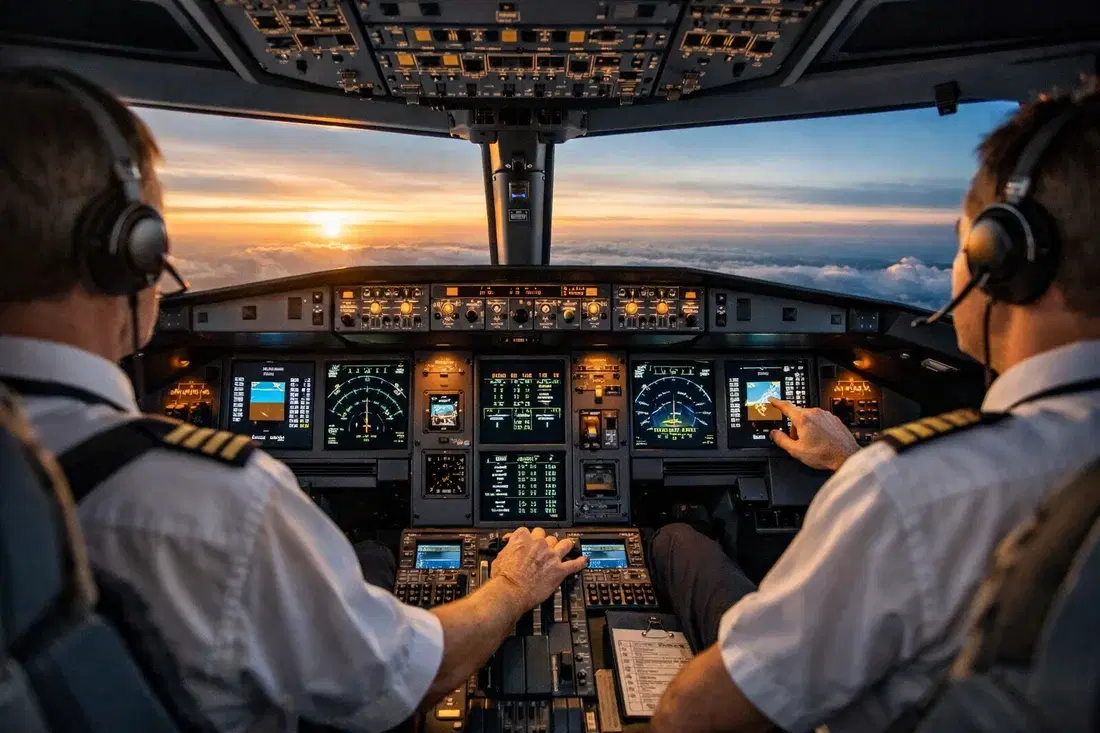
Short answer: not your next holiday flight, but sooner than most people think. AI is already flying cargo planes, helicopters and air taxis in tests. Passenger jets will keep two pilots for years yet, with AI working beside them as a copilot.
Here's where the technology really stands in 2026, what's coming next, and what it means the next time you board a plane.
Planes already fly themselves (mostly)
Modern airliners have flown on autopilot for decades. On a typical flight, pilots hand-fly only a few minutes around takeoff and landing. Autoland systems can even land a jet in thick fog.
The difference now is decision-making. Traditional autopilot follows instructions. AI systems aim to understand the situation: read the weather, talk to air traffic control, spot a runway, and react when something unexpected happens.
Small planes already have a taste of this. Garmin's Autoland can land a light aircraft on its own if the pilot becomes incapacitated: one button, and it picks an airport, flies there and touches down.
What's new in 2026
Who | What they're building | Where it stands |
|---|---|---|
Merlin Pilot, an AI that can fly an aircraft from takeoff to touchdown | Listed on NASDAQ in March 2026 after raising $200M; testing on US Air Force C-130J cargo planes | |
An H145 helicopter with no cockpit, flown by AI | Shown at ILA Berlin 2026; first flight (with safety pilot) planned late 2026 | |
Generation 6, a four-seat electric air taxi with no pilot on board | In flight testing; designed to be autonomous from day one |
Notice the pattern: cargo, helicopters and air taxis first. These have fewer people on board and simpler routes, so they're the testing ground before passenger jets.
When will it happen? A realistic timeline
Now (2026): AI assists pilots on test aircraft; autonomous cargo, helicopter and air taxi prototypes in flight testing.
Late 2020s: First uncrewed cargo and utility flights in limited areas; AI copilots helping crews with workload and checklists.
2030: Europe's aviation regulator, EASA, expects to decide on letting airliners fly with one pilot during cruise (pushed back from 2027).
Early 2030s: Airbus aims to put the uncrewed U145 helicopter into service; first autonomous air taxi routes possible.
2035 and beyond: Fully pilotless passenger jets, if ever. This depends on regulators and public trust, not just technology.
Safety, rules and trust
The biggest barrier isn't the technology. It's proving it is safer than two trained humans.
Regulators are cautious. EASA has delayed its decision on single-pilot cruise flights to 2030 and wants a gradual rollout of "smart cockpit" tech.
Pilots push back. Pilot unions argue two pilots are essential for safety. Europe's pilot association puts it simply: "One pilot means less safety, less security."
Passengers need convincing. Many travelers say they wouldn't board a plane without a pilot. Trust will likely be built step by step: first cargo, then air taxis, then airliners.
Where AI can clearly help today is as a second set of eyes: watching for pilot fatigue, spotting hazards and handling routine tasks so crews can focus on decisions.
What it means for travelers
For now, your flights will still have two pilots up front, with smarter systems helping them. Over the next decade, expect AI to show up first in places you'll notice: autonomous air taxis to the airport, faster turnarounds, and smoother operations behind the scenes.
One thing hasn't changed: wherever you land, you need to be online the moment you step off the plane, to book a ride, message family, or find your hotel.
CloudOn gives you a travel eSIM for 190+ countries. Install it before you fly and land already connected, with no SIM queues and no roaming shocks.
Get your travel eSIM at cloudon.app
FAQ
Can planes fly themselves today? Partly. Autopilot handles most of a modern flight, and autoland can land in poor visibility. But pilots still monitor, make decisions and take over when needed.
Will passenger planes ever have no pilots? Possibly, but not soon. Regulators are still deciding on single-pilot cruise flights, with Europe's decision expected in 2030.
What is an AI copilot? Software that helps pilots by handling routine tasks, monitoring systems and spotting risks, so the crew can focus on decisions.
Are autonomous air taxis coming? Yes, they're in flight testing now. Wisk's Generation 6 is designed to carry four passengers with no pilot on board.
Is AI flying safe? It has to prove it's at least as safe as human pilots before regulators approve it. That's why it's starting with cargo and test flights.
¿Listo para conseguir una eSIM?
Explora planes para más de 200 países. Compra en minutos, instala en segundos.