
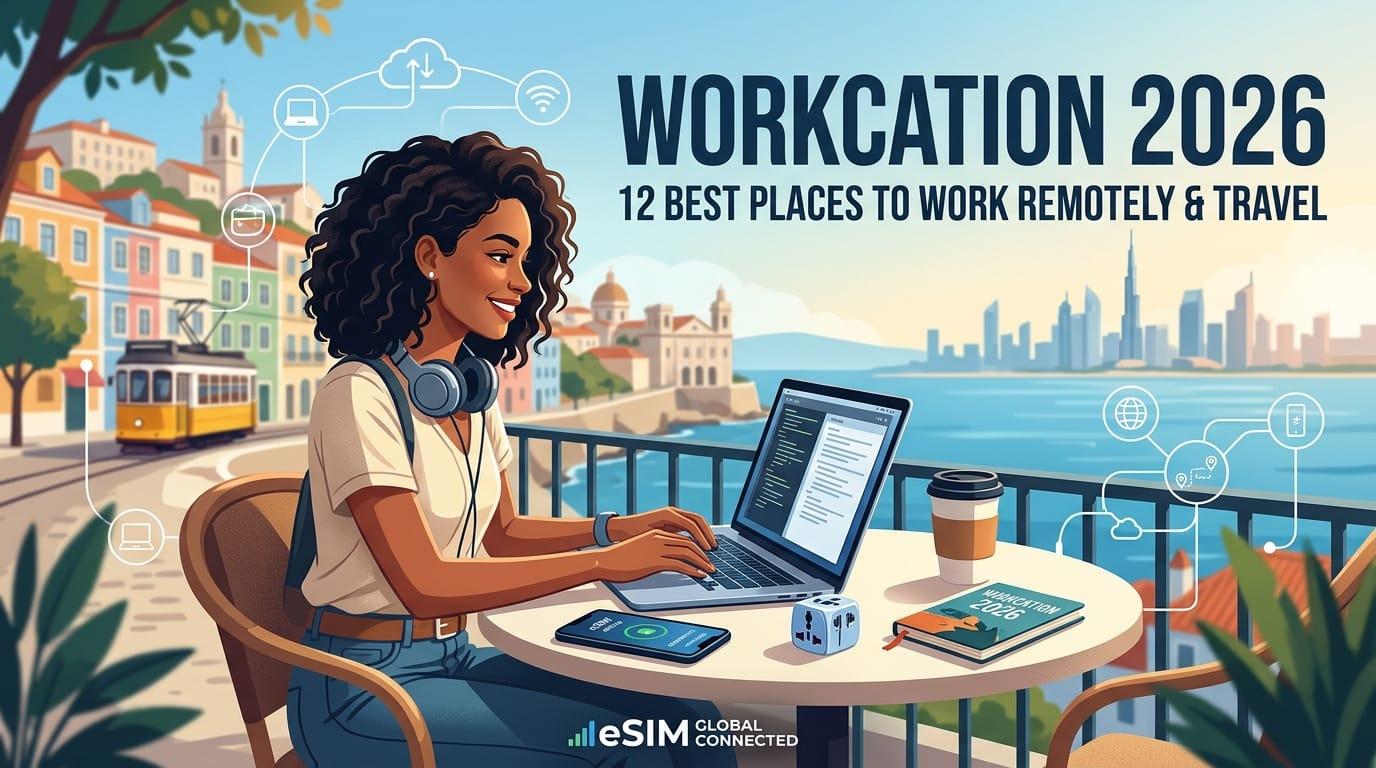
Combining professional responsibilities with meaningful travel is no longer a temporary experiment—it is a core lifestyle choice for millions of professionals worldwide. A workcation bridges the gap between traditional employment and slow travel, allowing remote employees, freelancers, and entrepreneurs to explore vibrant new environments without exhausting their paid time off or taking career sabbaticals.
In 2026, the global workcation trend has reached an unprecedented peak. Driven by expanded digital nomad visas, high-speed international mobile infrastructure, and dedicated coworking networks, living abroad while maintaining a career is easier than ever. Whether you want to answer emails from a sun-drenched cafe in Southern Europe, code alongside tropical beaches in Southeast Asia, or host video calls from a high-tech metropolis in East Asia, undertaking a workcation in 2026 offers an extraordinary balance of productivity and personal adventure.
This guide explores what makes a successful remote work trip, how to evaluate destinations, essential connectivity tools, and the 12 absolute best places to work remotely and travel this year.
What Is a Workcation?
A workcation—a blend of "work" and "vacation"—is a temporary trip where you carry out your normal remote job duties while living in a recreational or travel-focused destination. Unlike a traditional vacation, you are not unplugged from your job; you maintain standard working hours, deliver projects, and attend meetings.
To understand how a workcation fits into modern lifestyle choices, it helps to distinguish it from related concepts:
Workcation vs. Vacation: On a vacation, you completely disconnect from employment responsibilities to rest. On a workcation, your work routine continues, but your leisure hours (evenings and weekends) are spent discovering a new culture or city.
Workcation vs. Digital Nomad Lifestyle: Being a digital nomad often implies a continuous, location-independent lifestyle without a permanent base. A workcation is typically shorter or structured (ranging from two weeks to several months) and often serves as a temporary escape or trial period before returning home.
Workcation vs. Standard Remote Work: Standard remote work simply means working outside a traditional corporate office—often from home. A workcation intentionally relocates that home office to a destination chosen for its lifestyle, scenery, or cultural appeal.
Why Workcations Are Trending in 2026
The appetite for combining work and travel has grown exponentially, fueled by structural shifts in global work culture and technology:
Flexible Work Policies: Organizations have stabilized their remote and hybrid policies, shifting focus from rigid desk presence to asynchronous productivity and measurable output.
Expansion of Digital Nomad Visas: Over 60 countries now offer specialized visas designed for remote professionals, stripping away legal ambiguity and allowing extended legal stays.
Maturation of Travel Technology: Modern travel connectivity, particularly embedded SIM (eSIM) technology, allows travelers to connect to local cellular networks immediately upon arrival without swapping physical cards or relying on unsecured public Wi-Fi.
Global Infrastructure Improvements: High-speed fiber networks, widespread 5G rollouts, and global satellite internet have eliminated connectivity friction in both major capitals and rural retreats.
Burnout Prevention & Well-being: Professionals are actively seeking changes of scenery to combat burnout, using non-working hours to hike, surf, or immerse themselves in vibrant city life.
12 Best Places to Work Remotely and Travel in 2026
1. Lisbon, Portugal
+-----------------------------------------------------------------------+
| Location: Lisbon, Portugal                                            |
| Monthly Budget: $2,200 - $3,200 USD                                   |
| Internet Quality: Excellent (Fiber & 5G)                              |
| Best Time to Visit: May to June / September to October                |
+-----------------------------------------------------------------------+
Lisbon remains one of Europe's top hubs for remote workers, offering a balance of coastal charm, historic architecture, and modern tech infrastructure. Its vibrant expat community makes networking straightforward, while its mild climate allows for year-round outdoor exploration.
The city boasts high-speed fiber broadband and widespread 5G. Dozens of established coworking spaces—such as Second Home, LACS, and Enterprise Office—provide ergonomic workstations and quiet meeting booths. Internet speeds in apartments and cafes routinely exceed 100 Mbps.
Living costs in Lisbon have risen in recent years. A remote worker should budget between $2,200 and $3,200 per month, depending on accommodation choices. Renting outside the historic center (such as in Saldanha or Parques das Nações) significantly lowers expenses.
Non-EU/EEA citizens can utilize Portugal's D8 Digital Nomad Visa for longer stays, which requires proof of remote income (minimum thresholds apply, approximately four times the Portuguese minimum wage). For shorter stays, Schengen visa rules apply (90 days out of 180).
Lisbon is generally safe, though pickpocketing can occur on tourist trams (like Tram 28).
eSIM Recommendation: Opt for a regional Europe eSIM plan with network switching (e.g., connecting to MEO or Vodafone Portugal) to maintain fast mobile data while traveling between coastal areas and hills.
2. Barcelona, Spain
+-----------------------------------------------------------------------+
| Location: Barcelona, Catalonia, Spain                                 |
| Monthly Budget: $2,100 - $3,000 USD                                   |
| Internet Quality: Outstanding (National 5G Rollout)                   |
| Best Time to Visit: April to June / September to November             |
+-----------------------------------------------------------------------+
Barcelona seamlessly blends Mediterranean beach life with an energetic urban ecosystem. Remote workers are drawn to its world-class food scene, historic Gothic Quarter, and international atmosphere.
Wi-Fi reliability is rarely an issue in Barcelona. Modern cafes, shared office chains like OneCoWork and Aticco, and short-term apartments feature reliable fiber connections. Citywide public Wi-Fi is accessible, though a VPN should be used for sensitive tasks.
Expect a monthly budget of $2,100 to $3,000 USD. Gràcia, Poblenou, and Eixample are popular neighborhoods for remote workers looking for a balance of tranquility and proximity to central amenities.
Spain offers a dedicated Digital Nomad Visa for non-EU workers employed outside Spain, requiring proof of minimum monthly earnings. EU citizens can live and work freely without additional permits.
Exercise caution regarding petty crime, particularly pickpocketing along La Rambla and near beach avenues.
eSIM Recommendation: Choose an eSIM provider that hooks into local networks like Movistar or Orange Spain for high-capacity 5G connectivity during peak commuting hours.
3. Bali, Indonesia
+-----------------------------------------------------------------------+
| Location: Canggu / Ubud, Bali, Indonesia                              |
| Monthly Budget: $1,200 - $2,000 USD                                   |
| Internet Quality: Moderate to High (Varies by location)               |
| Best Time to Visit: April to October (Dry Season)                     |
+-----------------------------------------------------------------------+
Bali continues to attract remote professionals worldwide with its affordable lifestyle, tropical scenery, and established digital nomad culture. Canggu offers a beachside surfing lifestyle, while Ubud appeals to those seeking wellness, green space, and creative arts.
While internet reliability used to be an issue, major remote work hubs now feature dedicated fiber lines and backup generators. Elite coworking spaces like Tropical Nomad, Outpost, and BHub offer reliable connections and community events.
A comfortable lifestyle costs between $1,200 and $2,000 USD per month, covering villa rentals, dining out, scooter rentals, and workspace memberships.
Indonesia offers multiple visa options, including the B213 Single Entry Tourist Visa and specific remote work remote permits (such as the E33G Remote Worker Visa), allowing longer legal stays without incurring local income tax on foreign earnings.
Traffic congestion can be intense; renting a scooter requires experience and an International Driving Permit.
eSIM Recommendation: Secure an Indonesia eSIM that routes through Telkomsel, the provider with the widest coverage across Bali's suburban and rural zones.
4. Chiang Mai, Thailand
+-----------------------------------------------------------------------+
| Location: Chiang Mai, Northern Thailand                               |
| Monthly Budget: $900 - $1,500 USD                                     |
| Internet Quality: Excellent (Fast & Affordable)                       |
| Best Time to Visit: November to February                              |
+-----------------------------------------------------------------------+
Nestled in the mountains of Northern Thailand, Chiang Mai is famous for its low cost of living, peaceful ambiance, and welcoming community. It is often cited as the ultimate destination for first-time remote travelers.
Thailand boasts some of the fastest internet infrastructure in Southeast Asia. Coworking spaces like PunSpace and Yellow offer fast connections, ergonomic seating, and 24/7 access. Most local cafes provide free, reliable Wi-Fi.
Chiang Mai remains budget-friendly, requiring just $900 to $1,500 USD per month for a modern apartment, daily local dining, workspace passes, and weekend excursions.
Thailand offers tourist visas (extendable up to 60–90 days) alongside the Destination Thailand Visa (DTV), designed specifically for remote workers, freelancers, and cultural course attendees, valid for multi-entry over five years.
Be aware of the annual "smoky season" (February through April), when agricultural burning compromises air quality. Plan visits outside these months.
eSIM Recommendation: Use a Thailand eSIM powered by AIS or TrueMove H to ensure fast 5G connectivity while exploring mountain regions outside the main city.
5. Dubai, United Arab Emirates
+-----------------------------------------------------------------------+
| Location: Dubai, UAE                                                  |
| Monthly Budget: $3,500 - $5,500 USD                                   |
| Internet Quality: Exceptional (Ultra-Fast 5G Everywhere)              |
| Best Time to Visit: November to March                                 |
+-----------------------------------------------------------------------+
For remote workers seeking modern infrastructure, safety, and a central location between Europe, Asia, and Africa, Dubai is a compelling choice. The city features modern skyscrapers, luxury amenities, and zero local income tax for foreign earnings.
Dubai has fast mobile and fixed broadband speeds. Coworking venues like AstroLabs, Nest, and WeWork offer state-of-the-art infrastructure. Fiber connections are standard across apartments and hotels.
Living costs are high, ranging from $3,500 to $5,500 USD per month. Rent and high-end dining drive up expenses, though budget options exist in areas like Dubai Silicon Oasis or Jumeirah Village Circle.
The UAE’s Virtual Working Program allows foreign remote workers to reside in Dubai for one year while working for an overseas employer, provided they meet minimum monthly income criteria (approximately $3,500 USD/month).
Dubai is extremely safe with low crime rates. Be sure to respect local laws and customs regarding public conduct.
eSIM Recommendation: Purchase an eSIM with direct access to du or Etisalat networks for seamless high-speed connectivity across the emirate.
6. Istanbul, Türkiye
+-----------------------------------------------------------------------+
| Location: Istanbul, Türkiye                                           |
| Monthly Budget: $1,200 - $1,900 USD                                   |
| Internet Quality: Good in central districts                           |
| Best Time to Visit: April to May / September to November              |
+-----------------------------------------------------------------------+
Straddling Europe and Asia across the Bosphorus, Istanbul provides a unique cultural backdrop for a workcation. Neighborhoods like Kadıköy, Beyoğlu, and Moda feature historic architecture alongside modern coffee shops and workspace hubs.
Internet connectivity is reliable across primary commercial and residential districts. Coworking chains like Kolektif House and Han Space offer quiet environments and solid network infrastructure.
The cost of living for international remote workers remains favorable, averaging $1,200 to $1,900 USD per month, though inflation can affect local prices. Short-term apartment rentals offer good value.
Most nationalities can enter Türkiye on an e-Visa or visa-free entry for 30 to 90 days. Türkiye also offers a Digital Nomad Visa for qualifying remote workers between 21 and 55 years old who meet income requirements.
Istanbul is safe, but watch out for common urban tourist scams, especially around taxis and major landmarks like the Grand Bazaar.
eSIM Recommendation: Choose a local Türkiye eSIM connected to Turkcell or Vodafone Turkey to avoid steep international roaming surcharges.
7. Mexico City, Mexico
+-----------------------------------------------------------------------+
| Location: Mexico City (CDMX), Mexico                                  |
| Monthly Budget: $1,600 - $2,500 USD                                   |
| Internet Quality: Fast and widely available                           |
| Best Time to Visit: March to May / October to November                |
+-----------------------------------------------------------------------+
Mexico City is a cultural metropolis known for its culinary scene, museums, tree-lined avenues, and distinct neighborhoods like Roma Norte, Condesa, and Coyoacán.
High-speed internet is widely accessible in popular areas. Numerous remote-friendly cafes welcome laptop users, while spaces like WeWork and Homework provide quiet office environments.
A remote worker can live comfortably in Mexico City on $1,600 to $2,500 USD per month, covering rent in safe neighborhoods, daily dining, and cultural outings.
Mexico allows citizens of many countries to stay for up to 180 days on a standard FMM tourist permit upon arrival. For longer stays, Mexico’s Temporary Resident Visa is an accessible option for those demonstrating financial solvency.
Stick to reputable rideshare apps (like Uber or Didi) rather than street taxis, and exercise standard urban safety awareness, particularly at night.
eSIM Recommendation: Use an eSIM running on Telcel for reliable coverage across Mexico City and nearby towns like Puebla or Querétaro.
8. Medellín, Colombia
+-----------------------------------------------------------------------+
| Location: Medellín, Antioquia, Colombia                               |
| Monthly Budget: $1,100 - $1,800 USD                                   |
| Internet Quality: Solid with widespread fiber                         |
| Best Time to Visit: Year-round ("City of Eternal Spring")             |
+-----------------------------------------------------------------------+
Surrounded by the Andes Mountains, Medellín offers a pleasant climate, affordable living, and a welcoming local community. Neighborhoods like El Poblado and Laureles are popular bases for international remote workers.
Fiber internet is common across short-term accommodations, and coworking options like Selina and Ivy coworking spaces offer backup power and stable connections.
Monthly living costs range between $1,100 and $1,800 USD, making it one of South America's most cost-effective destinations for digital nomads.
Colombia offers a dedicated Digital Nomad Visa (Visa V Nómadas Digitales), valid for up to two years for remote workers employed outside Colombia, with simple income verification rules.
Stay mindful of personal safety ("no dar papaya"—don't flaunt valuables in public), use rideshare apps for transport, and avoid isolated streets after dark.
eSIM Recommendation: Get a Colombia eSIM powered by Claro or Movistar Colombia to maintain strong data coverage in metro areas and neighboring mountain villages.
9. Tallinn, Estonia
+-----------------------------------------------------------------------+
| Location: Tallinn, Estonia                                            |
| Monthly Budget: $1,800 - $2,600 USD                                   |
| Internet Quality: World-Leading Infrastructure                        |
| Best Time to Visit: May to August                                     |
+-----------------------------------------------------------------------+
As a digital-first society, Estonia offers an efficient environment for remote workers. Its capital, Tallinn, combines a preserved UNESCO World Heritage medieval old town with a tech sector (Telliskivi Creative City).
Estonia features world-class internet connectivity. Public Wi-Fi is fast, secure, and widely available, while coworking hubs like Lift99 and Workland cater directly to tech founders and remote professionals.
Living costs in Tallinn average $1,800 to $2,600 USD per month, offering EU living standards at a more accessible price point than Scandinavian destinations.
Estonia introduced the world's first official Digital Nomad Visa, allowing remote workers to stay legally for up to one year, provided they meet income thresholds.
Tallinn is exceptionally safe, with low crime rates, clean air, and efficient public transit. Winter months can be cold and dark, making summer the ideal season for a workcation.
eSIM Recommendation: Secure an eSIM supporting Telia or Elisa networks for seamless connectivity across Estonia and neighboring Baltic states.
10. Tokyo, Japan
+-----------------------------------------------------------------------+
| Location: Tokyo, Japan                                                |
| Monthly Budget: $2,500 - $3,800 USD                                   |
| Internet Quality: Exceptionally Fast & Reliable                       |
| Best Time to Visit: March to May / September to November              |
+-----------------------------------------------------------------------+
Tokyo provides a unique workcation backdrop, combining ultra-modern infrastructure with historic traditions. Areas like Shibuya, Shinjuku, and Akihabara offer endless entertainment, dining, and cultural exploration.
Japan’s internet infrastructure is fast and reliable. Workspaces such as WeWork Japan, Blitz, and modern "shared office booths" inside major train stations make taking confidential calls simple.
Expect a monthly budget of $2,500 to $3,800 USD, with accommodation being the main expense. Public transit and dining out remain surprisingly affordable relative to quality.
Japan offers a 6-month Digital Nomad Visa for eligible remote workers from select visa-exempt countries who meet specific annual income requirements. Standard tourist entries allow 90 days for many nationalities.
Tokyo is one of the safest major cities globally, featuring clean transit and respectful public spaces.
eSIM Recommendation: An eSIM configured for NTT Docomo or SoftBank ensures steady data speeds in dense underground subways and high-rise districts.
11. Cape Town, South Africa
+-----------------------------------------------------------------------+
| Location: Cape Town, Western Cape, South Africa                       |
| Monthly Budget: $1,400 - $2,300 USD                                   |
| Internet Quality: Good (Coworking backup essential)                   |
| Best Time to Visit: November to March (Southern Summer)               |
+-----------------------------------------------------------------------+
Cape Town features dramatic natural geography—dominated by Table Mountain and dual ocean coastlines—alongside a creative culinary and remote work scene. Neighborhoods like Sea Point, Camps Bay, and Gardens are popular remote bases.
Internet speeds are generally fast, but load-shedding (scheduled power outages) can affect local power grids. Consequently, choosing accommodation or coworking spaces (like Workshop17) equipped with solar power and back-up generators is essential.
Living costs range between $1,400 and $2,300 USD per month, allowing international workers to enjoy high-end dining, wine tours, and outdoor activities at accessible conversion rates.
South Africa offers a remote work visa option, alongside standard 90-day tourist entry stamps for many nationalities upon arrival.
Safety requires careful management: stay in secure areas, use private transport or Uber at night, and avoid displaying expensive electronic gear in unfamiliar public spaces.
eSIM Recommendation: Pick an eSIM connected to Vodacom South Africa for consistent mobile coverage along coastal routes and rural game reserves.
12. Kuala Lumpur, Malaysia
+-----------------------------------------------------------------------+
| Location: Kuala Lumpur (KL), Malaysia                                 |
| Monthly Budget: $1,100 - $1,800 USD                                   |
| Internet Quality: High-Speed Fiber Widespread                         |
| Best Time to Visit: May to July / December to February                |
+-----------------------------------------------------------------------+
Kuala Lumpur (KL) offers an urban Asian workcation experience with modern infrastructure, multicultural dining, and affordable high-rise living (often including rooftop infinity pools and gyms).
KL features strong internet connectivity. Apartment complexes, modern cafes, and dedicated coworking spaces like Common Ground and Colony offer reliable fiber internet speeds exceeding 100 Mbps.
Living costs in Kuala Lumpur are very competitive, averaging $1,100 to $1,800 USD per month for an upscale apartment in Mont Kiara or KLCC, dining, and leisure.
Malaysia offers the DE Rantau Nomad Pass, designed specifically for foreign digital nomads and IT professionals, allowing stays from 3 to 12 months (renewable for up to 24 months).
Kuala Lumpur is safe, easy to navigate in English, and offers a major transit hub (KLIA) for affordable travel across Southeast Asia.
eSIM Recommendation: Acquire a Malaysia eSIM that taps into Maxis or CelcomDigi networks for uninterrupted 5G connectivity throughout the city center.
How to Choose the Best Workcation Destination
                      WORKCATION DESTINATION EVALUATION
 ┌───────────────────┬───────────────────┬───────────────────┬───────────────────┐
 │   CONNECTIVITY    │    TIME ZONES     │    COST & VISA    │  SAFETY & HEALTH  │
 │ • Fiber internet  │ • Client overlap  │ • Monthly budget  │ • Low crime rate  │
 │ • Local 5G networks│ • Async workflows│ • Digital nomad   │ • Quality medical │
 │ • Backup options  │ • Meeting times   │   visa policies   │   facilities      │
 └───────────────────┴───────────────────┴───────────────────┴───────────────────┘
Selecting the right location for a workcation involves balancing work commitments with lifestyle preferences. Consider these core factors before booking:
Internet Reliability & Speed: Confirm that your accommodation provides verified Wi-Fi speeds (request a speed test screenshot from hosts) and verify that local 5G infrastructure is stable.
Time Zone Alignment: Ensure your destination matches your core working hours. Working a 9-to-5 US East Coast schedule while based in Southeast Asia means working night shifts, which can impact well-being and social life.
Cost of Living vs. Income: Calculate housing, workspace, meal, and transportation expenses. Choose destinations that fit comfortably within your income margin.
Visa Rules & Maximum Stays: Always verify entry rules. Overstaying tourist visas can result in fines or travel bans. Opt for countries with explicit digital nomad policies if planning stays beyond 30–90 days.
Safety & Healthcare Quality: Research local neighborhood safety, crime statistics, and international hospital networks. Purchase comprehensive international health insurance.
Community & Social Scene: Destinations with active remote work communities make it easier to network, join group activities, and avoid social isolation.
How to Stay Connected During a Workcation
Uninterrupted internet connectivity is non-negotiable for remote workers. Relying exclusively on hotel Wi-Fi or hunting for open cafes risks dropped meetings and security vulnerabilities.
Why You Should Arrange Mobile Data Before Departure
Arriving in a foreign country without data creates unnecessary stress. Arranging connectivity beforehand ensures you can instantly navigate transportation, contact hosts, access 2-factor authentication codes, and join urgent work calls right from the airport terminal.
How eSIMs Work for International Travelers
An eSIM (embedded SIM) is a digital SIM chip built directly into modern smartphones, tablets, and laptops. Instead of physically buying and swapping plastic SIM cards at airport kiosks, you install a digital cellular profile onto your device by scanning a QR code or activating it through an app.
When an eSIM Is Superior to Roaming or Public Wi-Fi
Connectivity Option | Convenience | Cost | Security | Reliability |
Travel eSIM | Instant digital install; keep home line active | Affordable local rates | High (encrypted cellular network) | High (direct local carrier connection) |
Carrier Roaming | Automatic connection | Extremely expensive daily fees | High | Moderate (dependent on carrier roaming agreements) |
Public Wi-Fi | No setup required | Free | Low (prone to interception) | Unpredictable (overcrowded, low bandwidth) |
What to Check Before Buying an eSIM
Country & Regional Coverage: Ensure the eSIM covers your specific destination or includes multi-country regional coverage if visiting several locations.
Data Allowance: Select data packages that fit your daily consumption (e.g., 5GB, 10GB, 20GB, or unlimited daily tiers).
Validity Period: Check how many days the plan lasts (e.g., 7, 15, 30, or 90 days) and when the activation clock starts.
Hotspot / Tethering Support: Confirm that the eSIM allows tethering so you can share cellular data with your laptop if Wi-Fi drops out.
Activation Process: Look for providers offering simple app installation or instant QR activation without requiring complex manual APN configuration.
Workcation Packing Checklist
To ensure your remote work trip runs smoothly, pack these essential items:
[ ] Primary Work Laptop & Charger (plus a lightweight protective sleeve)
[ ] Universal Travel Power Adapter (with built-in USB-C fast-charging ports)
[ ] High-Capacity Power Bank (20,000+ mAh, airline-compliant, for charging on the move)
[ ] Noise-Canceling Headphones (essential for working in cafes, hubs, and transit)
[ ] eSIM-Compatible Smartphone (unlocked by your home carrier)
[ ] Virtual Private Network (VPN) (installed on all devices for secure public network browsing)
[ ] International Travel & Health Insurance Policy (covering emergency medical costs and gear theft)
[ ] Physical & Digital Copies of Passport/Visas (stored securely offline)
Common Workcation Mistakes to Avoid
Relying Exclusively on Accommodation Wi-Fi: Always have a mobile hotspot or secondary connection ready. Property listings frequently overestimate Wi-Fi speeds.
Ignoring Visa Expiration Limits: Overstaying standard tourist permissions can trigger fines or deportation. Always verify current visa limits before booking extended travel.
Selecting Destinations Based Solely on Low Costs: Ultra-cheap locations may lack reliable infrastructure, quiet working spaces, or reliable power grids.
Miscalculating Time Zone Differences: Working across conflicting time zones can harm your sleep schedule and lower productivity.
Failing to Have Backup Internet: Experiencing network downtime during an important client presentation can compromise professional trust. Ensure you have mobile tethering active via a local or regional eSIM.
Frequently Asked Questions
What is a workcation?
A workcation is a travel experience where you continue performing your regular remote job duties while living in a tourist or lifestyle-focused destination, using non-working hours to travel and explore.
Is a workcation the same as being a digital nomad?
Not necessarily. Digital nomads usually live a long-term, location-independent lifestyle without a permanent home base. A workcation is often a shorter, structured trip (weeks to months) taken by professionals who maintain a primary residence.
Which country is best for a workcation in 2026?
The best country depends on your preferences. For top-tier infrastructure and safety, Tokyo (Japan) or Tallinn (Estonia) excel. For coastal lifestyles and networking, Lisbon (Portugal) and Barcelona (Spain) are top options. For affordability, Chiang Mai (Thailand) and Medellín (Colombia) offer great value.
How much does a workcation cost?
Monthly costs vary by destination. Budget options like Chiang Mai or Medellín cost $900 to $1,800 USD per month. Mid-tier destinations like Lisbon, Mexico City, or Tallinn range from $1,600 to $3,000 USD per month, while high-end spots like Dubai or Tokyo require $2,500 to $5,500 USD per month.
Do I need a digital nomad visa for a workcation?
For short stays (under 30 to 90 days), standard tourist visas or visa-waiver entries are commonly used by remote travelers. If you plan to stay long-term (6 to 12+ months), applying for an official digital nomad visa is recommended to remain legally compliant.
How do I get reliable internet while traveling?
Combine verified accommodation Wi-Fi with dedicated coworking memberships and an active travel eSIM on your unlocked smartphone. This setup provides immediate backup tethering if local Wi-Fi drops out.
Is an eSIM good for remote work?
Yes. An eSIM gives you access to local cellular data networks without physical SIM swaps, allowing high-speed LTE/5G internet sharing (hotspot) for laptops when Wi-Fi is slow or unavailable.
Can I use my phone as a hotspot during a workcation?
Yes, provided your mobile plan or international eSIM supports data tethering/hotspots. Check your plan's terms to ensure tethering is permitted without hidden throttling.
Conclusion
Planning a successful workcation in 2026 comes down to balancing destination appeal with reliable workplace logistics. By selecting locations with stable infrastructure, verifying visa requirements, and establishing solid backup connectivity, you can explore new cultures around the world without sacrificing productivity.
Before taking off, set up your mobile connectivity. Explore destination-specific travel eSIM plans to ensure instant, high-speed data access the moment your flight lands.
Ready to get an eSIM?
Browse plans for 190+ countries. Purchase in minutes, install in seconds.