
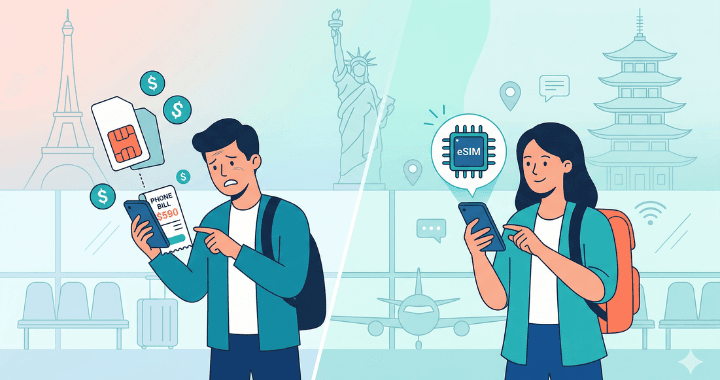
If you have ever returned from an international trip only to find a shockingly high phone bill waiting for you, you already know the pain of roaming charges. For decades, traditional international roaming was the only convenient way to stay connected abroad. But that is no longer the case. Travel eSIMs have emerged as a game-changing alternative, giving travelers affordable mobile data without the hassle of swapping physical SIM cards or dealing with unpredictable roaming fees.
So, is a travel eSIM better than roaming? How much can you actually save? And does the answer change depending on whether you are heading to Europe, the USA, or Asia?
In this comprehensive guide, we break down the travel eSIM vs roaming debate once and for all. We will compare costs, convenience, coverage, and speed so you can make the smartest choice for your next trip — whether it is a quick weekend getaway or a month-long business tour.
What Is International Roaming and How Does It Work?
International roaming is the default service that lets your existing mobile plan work when you travel outside your home country. Your carrier partners with networks in your destination, and you connect automatically. Sounds simple — and it is. But that simplicity comes at a steep cost.
When you roam internationally, your home carrier charges you premium rates for calls, texts, and data. These roaming charges can range from a few dollars per megabyte to well over ten dollars per megabyte in some regions. Even carriers that offer daily or weekly roaming add-ons typically charge between eight and fifteen dollars per day, which adds up quickly on longer trips.
Common Problems with Traditional Roaming
Unexpectedly high bills from background data usage
Slow speeds due to deprioritized network access
Limited or no control over which network you connect to
Complicated pricing tiers that vary by country and carrier
Risk of bill shock if you forget to turn off data roaming
For short trips where you barely touch your phone, roaming might feel manageable. But for most travelers, especially those visiting multiple countries or needing reliable data for maps, messaging, and work, traditional roaming is an expensive and frustrating option.
What Is a Travel eSIM and How Is It Different?
An eSIM, or embedded SIM, is a digital SIM that is built directly into your smartphone. Instead of inserting a physical card, you download a mobile data plan through an app or by scanning a QR code. A travel eSIM is simply an eSIM plan designed specifically for international travelers, offering prepaid data packages for specific countries or regions.
Here is why this matters: with a travel eSIM, you know exactly what you are paying before you leave home. There are no surprise charges, no per-megabyte fees, and no need to visit a local shop at your destination to buy a SIM card. You activate your plan digitally, often within minutes, and you are online the moment you land.
Key Advantages of Travel eSIMs
Transparent, prepaid pricing — you pay upfront and never exceed your budget
Instant activation from anywhere, no store visits required
Keep your primary number active on your physical SIM while using the eSIM for data
Switch between plans or providers without physically swapping cards
Multi-country and regional plans available for travelers visiting several destinations
Travel eSIM vs Roaming: A Detailed Cost Comparison
Let us get to the question everyone asks first: which is cheaper, a travel eSIM or international roaming? The short answer is that a travel eSIM is almost always significantly cheaper. But let us look at real numbers to understand the difference.
Roaming Costs by Region
Roaming rates vary widely depending on your home carrier and destination. Here is a general picture of what travelers typically face:
Europe: Most US carriers charge between $6 and $12 per day for roaming passes. Without a pass, data can cost $2 to $10 per megabyte.
USA (for inbound travelers): Roaming in the United States from international carriers often costs $8 to $15 per day or $5 to $12 per megabyte without a plan.
Asia: Rates are inconsistent. Japan and South Korea tend to be moderately priced, while roaming in Southeast Asia can be surprisingly expensive at $3 to $8 per megabyte.
Over a typical seven-day trip using moderate data (about 1 GB per day for maps, messaging, and light browsing), roaming charges can easily total $50 to $100 or more.
Travel eSIM Costs by Region
Travel eSIM plans are dramatically more affordable. Regional and country-specific plans typically offer the following price ranges:
Europe eSIM (multi-country, 5-10 GB, 7-30 days): $10 to $30
USA eSIM (5-10 GB, 7-30 days): $8 to $25
Asia eSIM (regional, 5-10 GB, 7-30 days): $8 to $25
Global eSIM (multi-region, 5-10 GB): $15 to $45
When you compare these figures directly, the savings become obvious. A traveler spending a week in Europe could save anywhere from 50 to 80 percent by choosing a travel eSIM over a carrier roaming plan. For frequent travelers or business professionals making multiple international trips per year, these savings compound into hundreds or even thousands of dollars annually.
eSIM vs Roaming for Europe Travel
Europe is one of the most popular destinations where the travel eSIM vs roaming debate plays out dramatically. While EU regulations have reduced roaming costs between European countries for European carriers, travelers coming from the US, Asia, or other regions still face hefty charges.
A European travel eSIM solves this elegantly. Most providers offer multi-country European plans that work across 30 or more countries, meaning you can hop from France to Germany to Italy without buying a new plan or worrying about additional charges. Compare that to roaming, where crossing borders can trigger different rate tiers from your home carrier, and the eSIM advantage is clear.
eSIM vs Roaming for USA Travel
International travelers visiting the United States often face some of the highest roaming rates in the world. A US travel eSIM provides reliable coverage on major American networks at a fraction of the cost. Plans are widely available with generous data allowances, and activation takes just a few minutes before your flight lands.
For business travelers especially, having a dependable data connection in the US without worrying about per-minute or per-megabyte charges is a major advantage. You can join video calls, access cloud documents, and use navigation apps freely without watching your data meter.
eSIM vs Roaming for Asia Travel
Asia presents unique challenges for roaming. The continent spans dozens of countries with vastly different telecom infrastructures and pricing models. Roaming charges in Japan might be reasonable through certain carriers, but neighboring countries like Thailand, Vietnam, or Indonesia can be significantly more expensive.
Regional Asia eSIM plans cover multiple countries under a single prepaid package. This is particularly valuable for travelers doing multi-country tours across Southeast Asia or East Asia. Instead of researching roaming rates for each country, you simply activate one plan and enjoy consistent pricing everywhere it covers.
Roaming vs eSIM for Short Trips: Is Roaming Ever Worth It?
This is a fair question. If you are traveling for just a weekend or two to three days, is it even worth setting up a travel eSIM? In most cases, yes — here is why.
Even for short trips, roaming charges accumulate quickly. A two-day roaming pass from a major US carrier can cost $20 to $25. A comparable eSIM plan for the same destination might cost $5 to $10 and offer more data. The setup process for an eSIM takes five minutes at most, so the time investment is minimal.
The only scenario where roaming might be more practical is if you truly need to make and receive calls on your primary number and cannot rely on Wi-Fi calling or VoIP apps. Even then, you can use a dual approach: keep your physical SIM active for calls (with data roaming disabled) while using an eSIM for all your data needs. This hybrid strategy gives you the best of both worlds.
Travel eSIM vs Buying a Local SIM vs Roaming: The Three-Way Comparison
Beyond the eSIM vs roaming debate, some travelers consider buying a local physical SIM card at their destination. This was once the go-to budget strategy, but it comes with its own drawbacks.
Why Local SIM Cards Are Losing Ground
You need to find a store, often at the airport or in the city, which eats into your travel time
Many countries require ID verification or registration, adding paperwork and delays
You lose access to your primary phone number unless your phone supports dual SIM
If you visit multiple countries, you may need to buy a new SIM in each one
Language barriers can make the purchase process frustrating
A travel eSIM eliminates every one of these friction points. You get local network rates without the local hassle, and you keep your primary number intact. For the vast majority of travelers, the eSIM is now the superior alternative to both roaming and physical local SIM cards.
eSIM vs Roaming for Business Travel
Business travelers have different needs from leisure tourists. Reliable connectivity is not just convenient — it is essential. Missed emails, dropped video conferences, and inaccessible cloud files can have real professional consequences.
Traditional roaming plans marketed to business users are often premium-priced, sometimes costing $15 to $20 per day. Over a five-day business trip, that is $75 to $100 just for basic connectivity. Corporate travel eSIM solutions, on the other hand, offer bulk pricing, centralized management, and flexible data allocations that make them far more cost-effective for companies sending employees abroad.
For individual business travelers, a prepaid travel eSIM still offers dramatic savings. You can choose high-data plans that support video calls and large file transfers, all at predictable, prepaid prices.
Roaming vs Travel eSIM: Pros and Cons at a Glance
Travel eSIM Pros
Significantly lower costs than roaming in nearly every scenario
Prepaid pricing with no surprise bills
Instant digital activation — no store visits, no shipping
Multi-country and regional plans for flexible travel
Dual SIM capability lets you keep your home number active
Travel eSIM Cons
Requires an eSIM-compatible device (most smartphones from 2020 onward support it)
Typically data-only, so calls and texts require VoIP apps
Requires initial setup, though this takes only a few minutes
International Roaming Pros
Zero setup — it works automatically when you land
Keeps your phone number fully active for calls and texts
Convenient for very light or emergency-only usage
International Roaming Cons
Expensive, especially for data-heavy usage
Unpredictable billing and potential for bill shock
Often slower speeds due to network deprioritization
Complex pricing that varies by carrier, country, and plan
How Much Can You Save with a Travel eSIM vs Roaming?
Let us put concrete numbers to this. Consider a traveler visiting three European countries over 10 days, using about 1 GB of data per day for navigation, messaging, social media, and occasional video calls.
Scenario: Roaming
Daily roaming pass at $10/day = $100 for 10 days
Data overage charges if you exceed the daily cap = additional $20 to $50
Total estimated cost: $100 to $150
Scenario: Travel eSIM
10 GB Europe-wide eSIM plan = approximately $15 to $25
No overage charges (data simply stops or you top up at a low rate)
Total estimated cost: $15 to $30
That is a potential savings of $70 to $120 on a single trip. For a family of four, multiply those savings accordingly. For frequent travelers taking four or five international trips per year, the annual savings could easily reach $500 or more.
Should You Use a Travel eSIM or Roaming? Making the Right Choice
The right choice depends on your specific travel situation. Here is a simple framework to help you decide:
Choose a travel eSIM if:
You want predictable, affordable pricing
You are visiting one or more countries and need reliable data
You are comfortable using WhatsApp, FaceTime, or other VoIP apps for calls
You travel internationally more than once or twice a year
You are a business traveler who needs dependable connectivity without expense report headaches
Stick with roaming if:
You rarely travel internationally and only need very light connectivity
You must receive traditional phone calls on your number and cannot use VoIP alternatives
Your carrier offers an exceptionally good international plan that rivals eSIM pricing (rare, but it exists)
For most travelers in 2026, the travel eSIM is the clear winner. The technology has matured, device compatibility is widespread, and the cost savings are too significant to ignore.
How to Get Started with a Travel eSIM
Getting set up with a travel eSIM is straightforward. Here is a quick walkthrough:
Check device compatibility: Most iPhones from the XS onward and most Android flagships from 2020 onward support eSIM. Check your phone settings under cellular or mobile data to confirm.
Choose a provider: Look for a reputable travel eSIM provider that offers plans for your destination. Compare data amounts, validity periods, and prices.
Purchase and activate: Buy your plan online or through the provider's app. You will receive a QR code or activation details. Scan it, and your eSIM profile will install in minutes.
Configure your phone: Set the eSIM as your data line and keep your physical SIM for calls if needed. Most phones make this easy through dual SIM settings.
Travel and enjoy: Your eSIM activates when you arrive at your destination. Use data freely within your plan limits, with no surprise charges waiting at home.
Final Thoughts: The Roaming Era Is Ending
The travel eSIM vs roaming comparison is becoming less of a debate and more of a settled question. Roaming served its purpose when there were no alternatives, but the combination of high costs, unpredictable billing, and inferior user experience has made it increasingly hard to justify.
Travel eSIMs offer everything modern travelers need: affordable prepaid data, instant activation, multi-country flexibility, and the convenience of keeping your primary phone number active. Whether you are exploring Europe, doing business in the United States, backpacking through Asia, or taking a quick weekend trip across the border, an eSIM is almost certainly the smarter, cheaper choice.
The next time you start planning an international trip, skip the roaming add-on from your carrier. Instead, spend five minutes setting up a travel eSIM. Your wallet — and your peace of mind — will thank you.
Ready to get an eSIM?
Browse plans for 190+ countries. Purchase in minutes, install in seconds.