
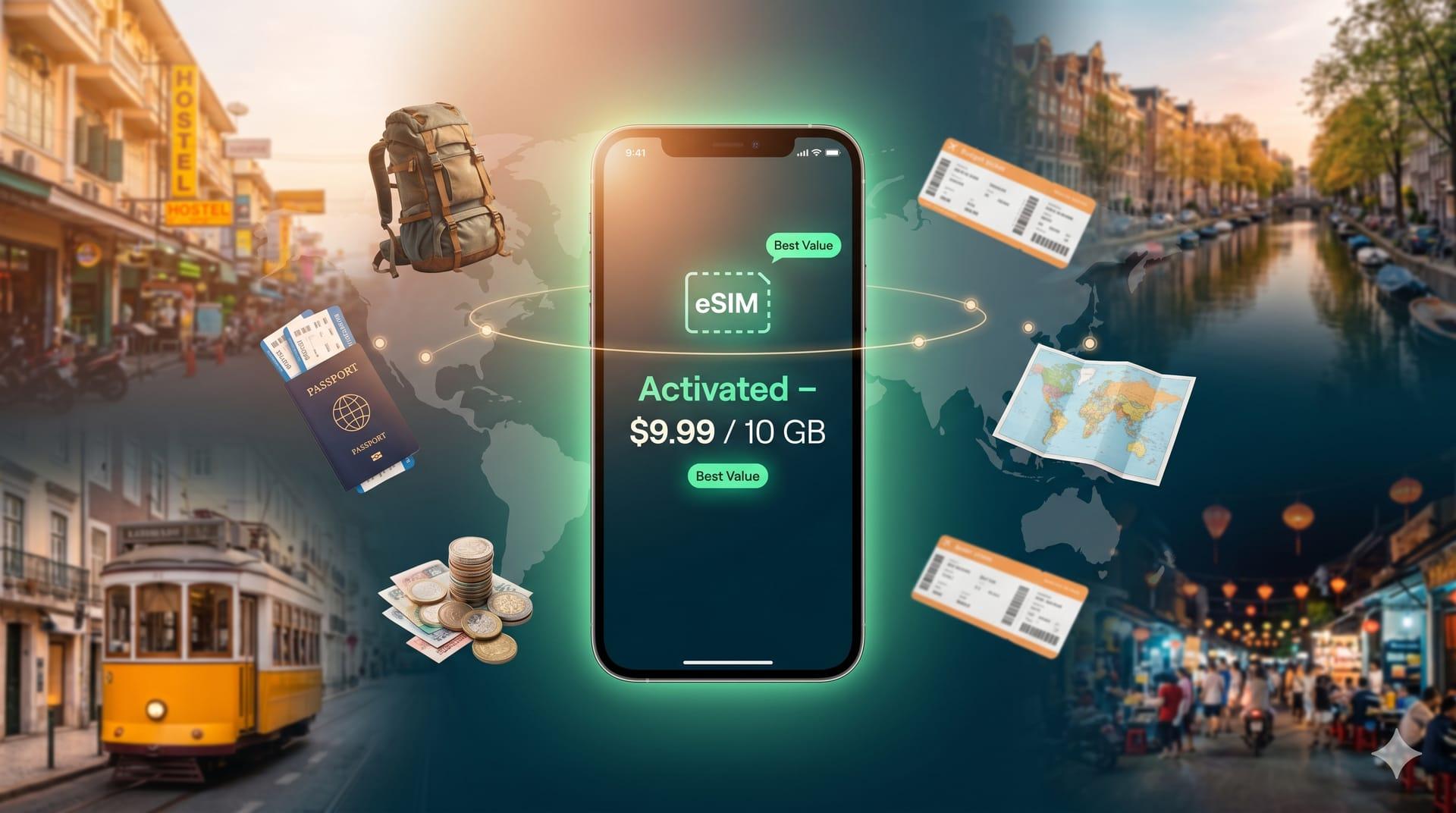
A student flying to Europe for a study-abroad semester. A backpacker stretching a gap year across Southeast Asia on a shoestring. A family of four trying not to spend their entire holiday budget on phone bills. Travelers in 2026 are reading the same headlines: data roaming bills can run hundreds of dollars per week, and even "travel-friendly" carrier add-ons rarely deliver real value. The good news is that a cheap eSIM for international travel now costs less than a couple of coffees and can keep you online across an entire trip.
The catch is that "cheap" means very different things to different providers. A 1 GB plan for 4 dollars sounds like a steal until you realize it lasts three days. A 50 GB "unlimited" plan looks generous until you discover the daily throttling cap kicks in after 1 GB. And the cheapest travel eSIM plans 2026 has to offer are often hidden behind promo codes, referral discounts, or subscription pricing that does not appear on the homepage.
This guide breaks down how to find the cheapest eSIM for international travel without sacrificing coverage, speed, or reliability. We will look at how cheap eSIM plans compare to roaming and local SIM cards, the best budget-friendly options by region (Europe, the USA, Asia), how to size data correctly for short trips and long stays, and the common traps that turn a cheap plan into an expensive mistake.
What "Cheap eSIM" Really Means for International Travel
A cheap eSIM for international travel is not just the plan with the lowest headline price. It is the plan that delivers the lowest cost per gigabyte of usable data over the actual length of your trip, on a partner network that performs reliably in your destinations. Three different travelers buying the "cheapest" plan in a comparison app can end up paying very different real costs depending on how their itinerary, data usage, and validity windows line up.
A 3-dollar plan that includes 1 GB over 7 days might be the cheapest if you only need maps and messaging on a long weekend trip. A 15-dollar plan with 10 GB over 30 days is usually cheaper per gigabyte for a two-week European tour. And a 30-dollar 50 GB plan is almost always the cheapest option per gigabyte for a backpacker on a two-month route. The cheapest plan is whichever one matches your trip — not the smallest one on the screen.
Why Budget Travelers Are Switching to a Cheap eSIM
For students, backpackers, gap-year travelers, families, and anyone watching their travel spending, a budget-friendly eSIM has become the default connectivity choice. Here is why:
Far cheaper than carrier roaming — most cheap eSIM plans cost 70 to 90 percent less than a roaming pack for the same data
No SIM card hunting at airports — you save hours and avoid currency-exchange traps at airport phone shops
Predictable upfront cost — pay once before the trip, with no surprise overage charges on the back end
Keep your home number active — your physical SIM stays in for calls and SMS while the cheap eSIM handles data
Stack promo codes and referrals — cheap travel eSIM apps frequently offer 10 to 30 percent off your first plan
Top up easily — running out of data on a budget plan costs a few dollars, not a triple-digit roaming bill
How to Find the Cheapest Travel eSIM Deals
Finding genuinely cheap travel eSIM plans takes about ten minutes of comparison. The difference between the right plan and the wrong one for the same itinerary can easily be 50 percent of the price. Four practical filters help cut through the noise.
Compare Per-Gigabyte Cost, Not Headline Price
The single biggest mistake budget travelers make is sorting plans by total price instead of price per gigabyte. A 5-dollar plan with 1 GB is 5.00 per GB. A 12-dollar plan with 5 GB is 2.40 per GB — less than half the unit cost. If both plans cover your countries and your trip length, the bigger plan is the "cheaper" plan in every real sense. Always divide cost by gigabytes before deciding.
Match Data Allowance to Trip Length
For a one-week trip with normal use (maps, messaging, social media, light browsing), 3 to 5 GB is usually enough. For a two-week trip, plan for 5 to 10 GB. For a month, 10 to 20 GB. Cheap eSIM with enough data for a 2 week trip usually means a 5 to 8 GB plan over 15 to 30 days, priced between 10 and 20 dollars depending on the region. Avoid buying tiny plans (500 MB to 1 GB) just because they are cheap — the per-GB cost is the worst on the market and you will burn the data in two days.
Use Travel eSIM Promo Codes and Discounts
Almost every major travel eSIM app runs promo codes, referral bonuses, and seasonal discounts. A 5-minute Google search for "[provider name] promo code 2026" before checkout typically saves 10 to 30 percent on your first plan. Many providers also offer first-purchase discounts inside the app, loyalty rewards on the second plan, and bonus data when you share a referral link with another traveler. None of these are advertised on the homepage, but they add up across a long trip.
Subscription vs Single-Trip Pricing
If you travel internationally more than twice a year, the cheapest travel eSIM plans are often subscription-based rather than per-trip. A 30-day refreshing global or regional plan at 10 to 20 dollars per month is far cheaper than buying a new 30-day travel eSIM every time you fly. Single-trip pricing still wins for occasional travelers, but for frequent flyers and digital nomads, a recurring plan is the lowest-cost path.
Cheap eSIM vs Roaming vs Buying Local SIM Cards
Travelers chasing the lowest connectivity cost usually weigh three options: a cheap travel eSIM, an international roaming pack from their home carrier, or buying a local prepaid SIM at the destination. Here is how the math actually plays out.
Cheap eSIM vs Roaming: Which Saves More?
Cheap eSIM almost always wins. A typical 10-day international roaming pack from a major U.S. or European carrier costs 60 to 120 dollars for 3 to 5 GB. The same coverage on a budget-friendly travel eSIM runs 8 to 20 dollars for 5 to 10 GB — often half the cost with double the data. The only scenario where roaming might tie is if your home carrier already includes free international roaming on your monthly plan (some EU carriers and a few U.S. plans). Even then, the included data is usually capped at low speeds, and a cheap eSIM with 4G or 5G speed costs a few dollars to add as a faster backup.
Cheap eSIM Plans vs Buying Local SIM Cards
A local prepaid SIM purchased on arrival can be the absolute cheapest option per gigabyte in some countries — Thailand, Vietnam, India, Turkey, and parts of Latin America offer extraordinary local rates. But that headline price ignores the cost of finding a store, navigating ID requirements, language barriers, taxi rides to phone shops, and the hour or more spent activating the plan. For multi-country trips, local SIMs almost always cost more once you account for time and the SIM you discard at the next border. A cheap travel eSIM bundles every country into one tap before you leave home, which is usually the smartest budget trade-off.
Cheap eSIM by Region: Europe, USA, Asia
Pricing varies sharply by region. The same provider can sell a 10 GB plan for very different prices in Europe versus the USA versus Asia, depending on local network partnerships. Here is what to expect in each major destination.
Low Cost eSIM for Europe Travel
Europe is the most competitive travel eSIM market in 2026, which is good news for budget travelers. Multi-country European plans covering 30 to 40 countries — Schengen, the UK, and a few extras — start at around 10 dollars for 5 GB over 30 days, with 10 GB plans landing between 15 and 25 dollars. For a two-week European tour, expect to pay 12 to 20 dollars for enough data to cover navigation, social media, and light hotspot use. Look for plans that include the UK explicitly, since post-Brexit it is excluded from some "EU only" packs.
Low Cost eSIM for USA Travel
The USA is more expensive on a per-GB basis than Europe or Asia because the wholesale rates from U.S. carriers are higher. Cheap eSIM plans for USA travel typically start around 12 dollars for 3 GB over 30 days, with 10 GB plans running 25 to 35 dollars. For a two-week U.S. trip, budget 15 to 25 dollars. Tourists visiting both the U.S. and Canada should look for combined North America plans — they are usually cheaper than buying two regional plans and avoid coverage gaps near the border.
Cheap eSIM for Asia and Southeast Asia
Asia has some of the lowest travel eSIM prices in the world, driven by aggressive competition between regional providers. A multi-country Southeast Asia plan covering Thailand, Vietnam, Cambodia, Laos, Malaysia, Singapore, and Indonesia runs 8 to 18 dollars for 5 to 10 GB over 30 days. Country-specific plans for Japan, South Korea, and Hong Kong are slightly more expensive but still cheap by global standards. For a three-week Southeast Asia loop, 10 to 15 dollars usually covers enough data for the whole trip.
Cheap eSIM by Traveler Type
Different traveler profiles need different "cheap." A weekend tourist, a year-long backpacker, and a study-abroad student have very different ideal plans even when the destination is the same.
Student-Friendly Cheap Travel eSIM
Students on exchange programs, summer study tours, or short academic trips usually need a balance of cost, data volume, and at least 30 to 90 days of validity. The best student-friendly cheap travel eSIM plans offer 10 to 20 GB over 30 days, often with extra discounts on student-verification services. For semester-abroad stays of three to six months, a recurring monthly plan beats buying long-validity plans up front.
Cheap eSIM for Backpackers and Gap Year Travelers
Backpackers and gap-year travelers usually cross many borders on tight budgets. The cheapest travel eSIM for backpackers is rarely the smallest plan — it is a larger fixed-data regional or global plan (20 to 50 GB) over 60 to 180 days. Per-gigabyte rates on bigger bundles are dramatically better, and a single profile carries through an entire backpacking route without reinstalls. Avoid "unlimited" plans aimed at backpackers — they almost always throttle to unusable speeds after a daily cap.
Cheap eSIM for Long Stay Abroad
For long stays of one to six months — slow travel, remote work, language schools, house-sitting — look for cheap eSIM plans with 30 to 90 day validity and generous data allowances (20 to 50 GB). Long-stay plans usually outperform a stack of shorter cheap plans on per-GB cost. If you exceed the original plan, top-ups inside the same profile are far cheaper than starting fresh, so pick a provider that supports easy in-app top-ups.
Cheap eSIM with Enough Data for a 2 Week Trip
A two-week trip is the sweet spot for cheap travel eSIM. Budget travelers should aim for a 5 to 10 GB plan over 15 to 30 days at 10 to 20 dollars total, depending on the region. That is enough headroom for daily Google Maps, WhatsApp, Instagram, email, and a couple of evening video calls without throttling. If your itinerary includes heavy hotspot use or daily video streaming, size up to 15 to 20 GB.
Cheap eSIM Unlimited vs Limited Data: Which Is Better?
Unlimited plans look like the obvious budget winner, but the cheapest plan on paper is not always the best deal. Here is the honest trade-off.
When unlimited cheap eSIM wins:
You genuinely need heavy data every day — video streaming, hotspot for laptop work, daily video calls
You hate tracking data balance and prefer one flat fee
Your trip is short (under 7 days) and the per-day rate works out lower than a fixed-data plan
When limited cheap eSIM wins:
Your typical daily use is under 1 GB — almost every unlimited plan throttles after 1 to 2 GB per day, so the "unlimited" only matters in theory
You want the best possible per-gigabyte cost — fixed-data bundles almost always win this number
You need consistent high-speed data all day long — fixed plans run at full speed until depletion, unlimited plans run at full speed only until the daily cap
For most budget travelers, a generous fixed-data plan (10 to 30 GB) at the same price as an unlimited plan will deliver more usable high-speed data and more flexibility. Pick unlimited only when daily usage is consistently above 2 GB and the throttled speed is acceptable for the rest of your day.
Common Mistakes When Hunting for a Cheap eSIM
Travelers chasing the lowest price often overpay by accident. The most common mistakes:
Sorting by headline price instead of per-gigabyte cost — the cheapest plan is rarely the smallest plan
Buying micro-plans (500 MB to 1 GB) for a real trip — you will burn through them in days and pay more in top-ups than a properly sized plan would have cost
Skipping promo codes and referral links — 10 to 30 percent discounts are routinely available with one Google search before checkout
Picking an "unlimited" plan without reading the daily throttling policy
Buying a separate cheap plan for each country on a multi-stop trip instead of one regional plan that covers them all
Ignoring validity windows — a 5 GB plan over 7 days at 5 dollars looks cheap, but a 10 GB plan over 30 days at 12 dollars is far cheaper per gigabyte and per day
Forgetting to disable data roaming on the home SIM — a single missed setting can wipe out everything you saved on the eSIM
Trusting plans with no named partner carriers — wholesale-only routes often deliver slow speeds that make the "cheap" plan unusable
Final Thoughts: Cheap Does Not Mean Compromised
Cheap eSIM for international travel in 2026 is no longer a compromise. Competition between providers has pushed prices low enough that a properly sized, well-chosen budget plan delivers the same coverage, speed, and reliability as plans costing two or three times as much. The trick is knowing how to compare — per gigabyte, not per plan — and avoiding the small handful of traps that turn a cheap plan into an expensive one.
Quick recap for budget travelers:
Two-week trip: a 5 to 10 GB regional plan over 15 to 30 days for 10 to 20 dollars
Backpacker or gap-year route: a 20 to 50 GB regional plan over 60 to 180 days, skipping unlimited gimmicks
Student abroad for a semester: a recurring monthly plan with 10 to 20 GB, plus student discounts where available
Family on holiday: one regional plan per phone, sized to each user — usually cheaper than a shared family pack
Long stay abroad: a long-validity plan with in-app top-ups, beating a stack of short plans on cost per gigabyte
Frequent flyer on a tight budget: a subscription-style monthly plan, not new per-trip plans every time you fly
A roaming bill that costs more than a domestic flight used to be the price of staying connected abroad. In 2026, a cheap travel eSIM costs less than a single restaurant meal and works in more countries than your home carrier has ever heard of. Compare per gigabyte, match the plan to your route, and the budget option becomes the smart option — exactly as it should be.
Ready to get an eSIM?
Browse plans for 190+ countries. Purchase in minutes, install in seconds.