
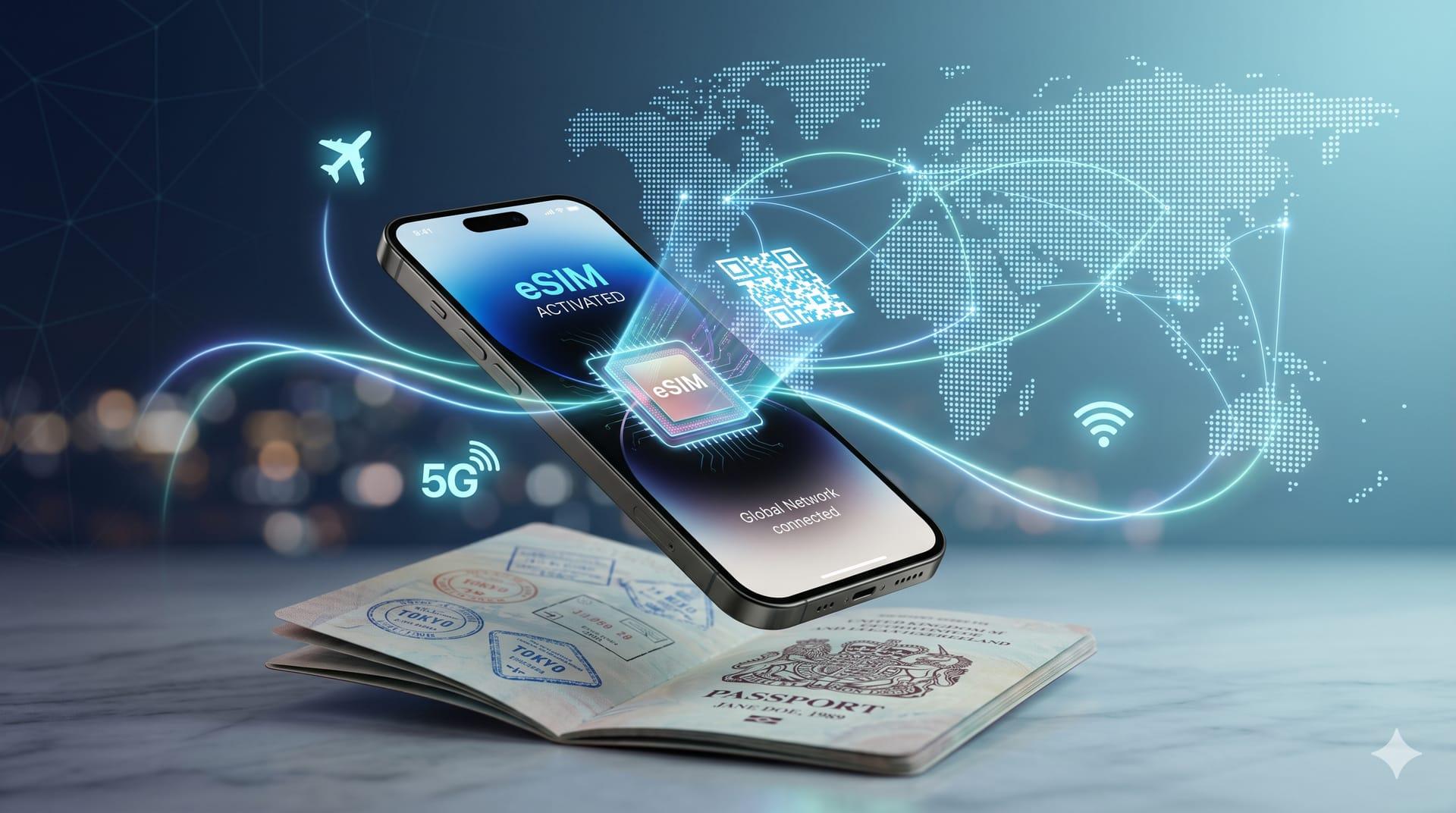
If you travelled internationally even five years ago, you probably remember the ritual: land at the airport, hunt for a kiosk, hand over your passport, wait for activation, and hope the tiny plastic chip in your hand would keep you online for the rest of your trip. In 2026, that ritual is officially over. A quick scan of a QR code from your sofa at home, and your phone is ready for the road.
The travel eSIM market is no longer a curiosity. It is one of the fastest-growing segments in global telecom, with market valuations landing somewhere between USD 0.7 billion and 1.8 billion for 2025–2026 and strong CAGR projections running through 2035. Consumers, digital nomads, and enterprises are all replacing roaming contracts with app-based eSIM plans, and telecom operators are rebuilding their business models around the shift.
This guide breaks down the most important eSIM trends 2026 travelers and businesses need to understand — from 5G rollout and MVNO convergence to Connectivity-as-a-Service (CaaS) and IoT eSIM — and shows you how to pick the best eSIM for international travel in 2026 based on how you actually travel.
Why eSIM Is Redefining Travel Connectivity in 2026
For decades, international mobile data came with two bad options: pay eye-watering roaming charges to your home carrier, or spend the first hour of your vacation queuing at an airport SIM vendor. Neither was pleasant, and neither scaled for the way people travel today — multi-country itineraries, remote work, and back-to-back business trips across continents.
An eSIM — short for embedded SIM — solves all of that. Instead of a plastic card, your phone stores a digital profile provisioned over the air. You can download a travel eSIM plan from an app, install it before you leave home, and connect to a local network the moment you land. No swapping, no waiting, no losing your home SIM.
Three shifts made 2026 the year eSIM moved from early-adopter tech to mainstream travel essential:
Device ubiquity. Nearly every flagship smartphone released since 2022 supports eSIM, and many 2024–2026 models are eSIM-only in key markets.
Provider competition. Dozens of travel eSIM apps now compete on price, coverage, and UX, pushing per-gigabyte costs down and feature quality up.
Regulatory pressure. Roaming regulations, consumer protection rules, and growing transparency demands have made opaque roaming bills harder to defend.
Put simply, 2026 is the first year most international travelers default to a travel eSIM rather than roaming or a local SIM. And the trends below are accelerating that shift.
Top eSIM Trends Shaping 2026
Here are the five eSIM trends 2026 that matter most — whether you are a tourist planning a two-week holiday, a digital nomad scouting your next base, or a telecom strategist building the next wave of connectivity products.
1. Travel eSIM Goes Fully Mainstream
The travel eSIM market is no longer niche. Analyst estimates for 2026 cluster in the high hundreds of millions to low billions of USD, with strong double-digit CAGR forecasts running into 2030 and beyond. The biggest drivers are simple: smartphones that support eSIM out of the box, rapid rebound in international travel, and consumers who have had enough of roaming bill shock.
What this means for travelers in 2026:
More providers, lower prices. Competition between global travel eSIM apps has driven down per-gigabyte costs, with many regional plans now available for single-digit dollar amounts.
Better regional packs. Multi-country eSIM plans now routinely cover 30 to 70+ countries under a single profile, making them ideal for multi-stop trips across Europe, Asia, or Latin America.
Longer plan durations. Long-term travel eSIM plans covering 30, 60, and 90 days are now standard, not exceptional — a direct response to the rise of slow travel and remote work.
2. 5G Coverage Expansion Meets Travel Data
5G networks are finally hitting the scale where travelers feel the difference day-to-day. Coverage is strong across most of Europe, North America, the Gulf, Japan, South Korea, and urban Southeast Asia. In 2026, the best travel eSIM apps partner with tier-one carriers that expose 5G access to visiting devices, not just home subscribers.
Why this matters:
Video calls actually work. Remote workers and digital nomads can now run full-HD meetings from cafes and co-working spaces on eSIM data in most major cities.
Hotspot sharing is usable. 5G makes using your travel eSIM as a laptop hotspot genuinely practical, even for heavier tasks like uploading footage or syncing large cloud drives.
Throttled "unlimited" plans feel less painful. When full-speed data is this fast, even fair-use caps stretch further before you notice the slowdown.
When comparing the best eSIM for international travel 2026, 5G access is no longer a bonus feature — it is table stakes.
3. MVNO + Travel eSIM Convergence
One of the most important eSIM trends 2026 is happening behind the scenes: mobile virtual network operators (MVNOs) are quietly folding travel eSIM into their core offerings. Instead of losing customers to third-party travel eSIM apps the moment they leave the country, MVNOs are bundling domestic plans with travel eSIM coverage — protecting retention and creating a new revenue line at the same time.
For travelers, this shows up as:
Home-plus-abroad bundles from your existing domestic MVNO, often at better rates than buying separately.
Pre-installed travel eSIM profiles in MVNO apps, with one-tap activation when you land overseas.
Unified billing across local and international usage, which is especially attractive for frequent flyers and small business owners.
For MVNOs and digital brands watching this space, the MVNO and travel eSIM bundle is one of the clearer growth plays for 2026 — turning roaming from a customer-loss event into a repeat purchase.
4. Connectivity-as-a-Service (CaaS) Platforms
Behind many of the travel eSIM apps you see in the App Store sits a less visible but equally important trend: Connectivity-as-a-Service. CaaS platforms expose telecom functions — eSIM provisioning, data plan management, coverage intelligence, usage analytics — through APIs so that non-telecom brands can launch their own connectivity products without signing 20 carrier contracts.
In 2026, CaaS is powering:
Fintech and neobank apps that offer travel data alongside FX and travel insurance.
OTAs and travel super-apps that add an eSIM tab next to flights and hotels.
Loyalty programs that reward miles with travel data credit rather than just upgrades.
Corporate travel platforms that provision eSIM to employees at the moment a trip is booked.
For brands, CaaS means you can launch a travel eSIM business in weeks rather than years. For travelers, it means connectivity becomes a quiet, embedded feature of the apps you already use — not a separate product you have to remember to buy.
5. IoT eSIM Everywhere
Not every eSIM story is about travelers. A huge portion of 2026 growth is in IoT — shipping containers, rental vehicles, cold-chain pallets, smart meters, tracking devices, wearables, and connected cameras. IoT eSIM plans, often using remote SIM provisioning standards, give these devices global connectivity with multi-network failover and the ability to switch operators over the air.
For logistics, fleet, and supply-chain operators, IoT eSIM delivers:
Global coverage across borders without swapping SIMs at every crossing.
Redundancy through multi-network profiles that roam to the strongest signal.
Scale via centralized management dashboards that handle millions of endpoints.
Security through identity-tied provisioning and zero-touch deployment.
Even if you are a traveler and not a logistics manager, the IoT eSIM trend matters indirectly — the same core technology powers the networks you rely on when you rent a car, track a delivery, or use a smart lock at a short-term rental.
Travel eSIM vs Roaming in 2026: Why Roaming Is Dying
Ask any frequent traveler what changed most between 2019 and 2026, and the answer is usually the same: they stopped using international roaming. Here is why travel eSIM vs roaming has become such a lopsided comparison.
Cost. Traditional roaming still averages anywhere from USD 5 to USD 15 per day for travel passes, with per-megabyte rates climbing into the absurd if you go off-plan. A travel eSIM can deliver 5 to 10 GB over 7 to 14 days for USD 8 to 20 — often less than a single day of roaming.
Transparency. Roaming bills notoriously land after the trip, with surprise charges for calls, texts, and data you did not realize were metered. Travel eSIM plans are prepaid. You know exactly what you paid before your flight takes off.
Activation speed. A travel eSIM installs in under two minutes. It connects automatically when you land. Roaming requires trusting that your carrier's partner agreements actually work in your destination — which is not always the case, especially off the beaten path.
Control. With a travel eSIM, you can keep your home SIM active for calls and texts while using the eSIM purely for data. You retain your primary number without paying roaming rates. Roaming forces you to use your home line for everything, including data you did not want to use.
Multi-country coverage. A single Europe, Asia, or global eSIM plan often covers 30 to 70+ countries. Roaming typically treats each country as a separate zone with separate pricing and different rules.
For short trips, long stays, backpacking, digital nomading, family vacations, or business travel — the math keeps pointing in the same direction. In 2026, roaming makes sense almost exclusively for last-minute trips where you simply did not have time to install an eSIM before boarding.
Choosing the Best eSIM for International Travel in 2026
There is no single "best" travel eSIM. The right plan depends on how you travel, how long you will be away, and what you actually use your phone for. Here is how to match your trip type to the right eSIM.
Best eSIM for Short Trips and Tourists
For trips of 3 to 14 days — a weekend in Lisbon, a week in Tokyo, 10 days in Mexico — look for a plan with 3 to 10 GB of data and broad country coverage. This range handles maps, messaging, ride-shares, and social media for most travelers without overbuying. Prioritize simple activation, same-day support, and plans that start counting validity from first use rather than purchase.
Best eSIM for Digital Nomads
Digital nomads need more than casual tourist connectivity. If you are working remotely from Lisbon, Bali, Medellín, or Tbilisi, you need consistent fast data for video calls, cloud tools, and always-on messaging. Look for long-term travel eSIM plans (30 to 90 days) with 20 GB or more, hotspot sharing, and 5G access where available. Regional plans that cover entire continents — Europe, Southeast Asia, Latin America — pair well with a slow-travel lifestyle, letting you hop between bases without buying a new plan each time.
Pair your travel eSIM with a reliable VPN, and you have a solid remote-work connectivity stack that travels with you.
Best Multi-Country eSIM for Travel
Backpackers, cruise passengers, and round-the-world travelers benefit most from multi-country eSIM plans. One profile, many borders. Look for plans that explicitly include every country on your itinerary — do not assume "Europe" covers the UK, Switzerland, or Turkey, and do not assume "Asia" covers Japan or South Korea. The best multi-country travel eSIM plans in 2026 cover 30 to 70+ countries and offer top-ups if you burn through your data faster than expected.
Best eSIM for Business Travelers
Business travelers value reliability, reimbursable billing, and predictable coverage more than the lowest per-gigabyte price. A mid-tier plan on a tier-one network, with clear invoices and responsive support, is usually worth more than saving USD 3 on a budget provider. If your company has more than a handful of regular travelers, it is worth exploring corporate travel eSIM solutions — centralized billing, policy controls, and bulk purchasing can cut international data spend dramatically while simplifying expense workflows.
Best Global eSIM Plan
If you genuinely travel across multiple regions in a single trip — London, Dubai, Singapore, Sydney — a global eSIM plan can simplify your life even if it costs more per gigabyte than regional packs. Alternatively, buy two or three regional plans and switch between them. Most modern smartphones support multiple eSIM profiles and toggling between them takes seconds. For frequent flyers, a global travel eSIM subscription that refills monthly is emerging as a neat "set and forget" option.
Best Cheap eSIM for International Travel
Budget travelers, students, and backpackers understandably chase the lowest price. That is fine — but compare cost per gigabyte rather than sticker price, and check the fair-use policy before celebrating a deal. A cheap eSIM for international travel with aggressive throttling or patchy coverage often costs you more in lost time and missed connections than a mid-tier plan would have. Promo codes, first-time discounts, and referral credits are common in this space and worth a quick search before checkout.
How to Set Up a Travel eSIM Before Your Trip
Setting up a travel eSIM is simple once you have done it once. Here is the six-step flow most travelers follow in 2026.
Step 1: Confirm device compatibility. Most iPhones from the XS (2018) onward and most Android flagships from 2020 onward support eSIM. Check your phone settings for "Add eSIM" or "Add Cellular Plan."
Step 2: Pick your plan. Match plan duration, data allowance, and country coverage to your trip. Compare at least two providers.
Step 3: Purchase and receive. Buy through the provider's app or website. You will get a QR code or direct install link within minutes.
Step 4: Install the profile at home. Scan the QR code over stable Wi-Fi before you leave. Do not wait to install at the airport.
Step 5: Configure dual SIM. Set the travel eSIM as your data line and keep your home SIM for calls and texts. Disable data roaming on your home SIM to avoid accidental charges.
Step 6: Land and connect. Your eSIM should connect automatically on arrival. Some plans activate on first network connection; others from the purchase date. Verify before you travel.
Mistakes to Avoid When Buying a Travel eSIM
Even in 2026, travelers make the same handful of avoidable mistakes:
Skipping the coverage check. Never assume a regional plan covers every country on your route. Verify each destination before buying.
Installing at the airport. Install at home on stable Wi-Fi. Airport networks are unreliable and slow.
Forgetting to disable home-SIM data roaming. Otherwise your phone may silently route traffic through your home carrier at full roaming rates.
Chasing "unlimited" without reading fair-use terms. Most unlimited travel eSIM plans throttle after 1 to 2 GB per day. Sometimes a 15 GB fixed plan is better real-world value.
Ignoring support quality. If something breaks abroad, responsive 24/7 support is priceless. Read recent reviews, not year-old ones.
Losing your QR code. Save your eSIM details in email and a screenshot. You may need to reinstall if you switch devices.
The Future: What Comes After 2026?
The best eSIM for international travel 2026 will look slightly outdated by 2028, and that is a good thing. Here is what is already on the horizon.
iSIM goes mass-market. iSIM — integrated SIM — embeds the eSIM directly into the device processor. It frees up space, reduces power draw, and makes connectivity a more seamless part of every device, especially wearables and small IoT endpoints.
Network APIs and CaaS mature. Expect travel apps, banks, airlines, and OTAs to embed connectivity as a default feature, not a separate purchase. The phrase "buying a travel eSIM" may fade as connectivity becomes something you simply have.
5G Advanced and early 6G pilots. Travel data speeds will keep climbing. Network slicing may let you pay for prioritized data during specific moments — a live broadcast, a client call, a flight check-in — rather than a flat bucket.
AI-assisted connectivity. Expect phones and travel apps to proactively recommend the best plan for your upcoming itinerary, install it automatically, and optimize which network you connect to at each location. Connectivity becomes a background service, not a decision you make every trip.
Stronger B2B adoption. Corporate travel eSIM solutions, IoT eSIM, and MVNO + travel bundles will see the fastest growth through 2027–2028 as enterprises migrate off legacy roaming contracts and build connectivity into their product experiences.
Final Thoughts: What the eSIM Trends 2026 Mean for You
The 2026 eSIM landscape is defined by one simple reality: affordable, flexible, app-based connectivity has finally won. Whether you are a weekend tourist, a digital nomad, a business traveler, or a telecom operator rethinking monetization, the opportunities are bigger than ever.
For travelers, the practical takeaway is small and actionable: spend five minutes before your next trip choosing a travel eSIM that matches your itinerary, install it from your sofa, and land with working data. No roaming surprises. No airport queues. No guessing whether your home carrier's partner network actually works in this country.
For operators, MVNOs, and brands, the strategic takeaway is bigger: travel eSIM, MVNO bundles, CaaS, and IoT eSIM are reshaping how connectivity gets packaged and sold. The winners in the next three years will be the ones who treat eSIM not as a product line but as a platform — a way to embed global data into every travel, fintech, logistics, and enterprise experience.
Either way, 2026 is not a trend year to watch and wait on. It is the year to act. Pick the right travel eSIM for your next trip, and stay connected wherever the road takes you.
Ready to get an eSIM?
Browse plans for 190+ countries. Purchase in minutes, install in seconds.